The Next Manifest Destiny: Why America's Future is Written in Red Dust
The New American Frontier
In the mid-19th century, journalist John O’Sullivan coined a phrase that would define the American ethos for generations: Manifest Destiny. It was the providential argument that the United States was destined to expand across the North American continent, from the Atlantic to the Pacific. Today, in 2026, that spirit has been resurrected, but the wagons are no longer drawn by oxen—they are propelled by methalox engines, and the frontier is no longer the Oregon Trail, but the Hohmann transfer orbit to Mars. The red dust of the Martian surface represents the ultimate prize in a new era of expansionism where Silicon Valley libertarianism collides with Washington’s grand strategy.
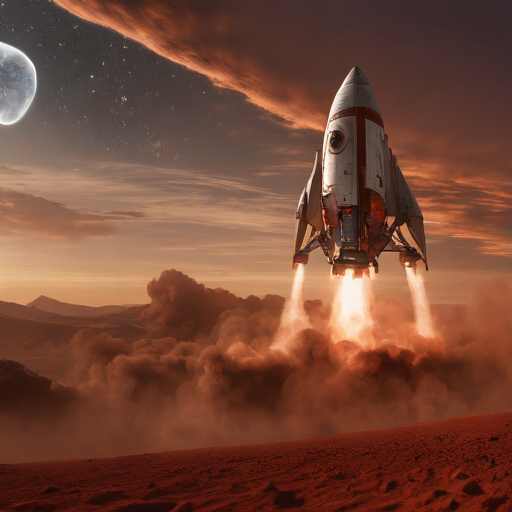
This is not merely scientific curiosity; it is the establishment of a multi-planetary insurance policy for the American experiment. The parallels between the westward expansion of the 1840s and the upward expansion of the 2020s are striking. Just as the transcontinental railroad unlocked the economic potential of the West, the drastic reduction in launch costs spearheaded by SpaceX’s Starship architecture is unlocking the solar system. We are witnessing the transition from space exploration as a prestige project to space colonization as an economic imperative. The "New American Frontier" is defined by a distinct shift in leadership: where NASA once dictated every bolt and trajectory, they now serve as the anchor tenant for a booming private infrastructure.
The Cost of Access: Launch Price History & Projections (USD per kg to LEO)
The chart above illustrates the single most disruptive factor in this new race: the collapse of the cost-to-orbit barrier. In the shuttle era, space was the domain of sovereigns because only sovereigns could afford the $54,500 per kilogram price tag. Today, with commercial heavy-lift capabilities approaching $200 per kilogram, the barrier to entry has shattered. This democratization of access allows US interests to flood the zone—deploying mega-constellations, orbital manufacturing hubs, and fuel depots at a pace that state-run programs cannot match.
However, this commercial agility is being channeled into a rigid geopolitical container. The looming shadow of the People’s Republic of China and its ambitious International Lunar Research Station (ILRS) has galvanized Capitol Hill. Much like the Cold War spurred the Apollo program, the threat of Beijing establishing a "de facto" sovereignty over strategic lunar poles or Martian landing sites has forced a bipartisan consensus: America must be there first, and it must be there to stay. The US Space Force, established just years ago, is now integral to protecting these commercial arteries, ensuring that the "high seas" of space remain open to American enterprise.
From Apollo to Artemis: A Legacy Reborn
For more than half a century, the footprints left by Neil Armstrong and Buzz Aldrin on the Sea of Tranquility have stood as the ultimate monument to American exceptionalism—a silent, static testament to a time when the United States galvanized its industrial and political will to achieve the impossible. But for decades following the final splashdown of Apollo 17 in 1972, that monument risked becoming a tombstone for ambition, as low-Earth orbit became the ceiling of our aspirations. Today, however, the dormant machinery of American exploration is roaring back to life, not with the singular, state-directed force of the 1960s, but with a complex, vibrant ecosystem that blends the heritage of NASA with the disruptive velocity of Silicon Valley. The Artemis program, named for Apollo’s twin sister, represents far more than a sequel to the moon landings; it is the foundational infrastructure for the next great American migration.
Unlike the Cold War sprint to the Moon, which was fundamentally a race for ideological supremacy driven by a "flags and footprints" mandate, the Artemis era is defined by permanence. The objective is not merely to go, but to stay. This shift in strategy is necessitated by a harsh economic reality: the Apollo program, at its zenith, consumed roughly 4.4% of the US federal budget. Today, NASA operates on less than 0.5%. This fiscal constraint has birthed the most significant innovation in modern spaceflight—the public-private partnership. While the Space Launch System (SLS) and the Orion capsule represent the traditional "cost-plus" contracts and the reliable engineering might of incumbents like Boeing and Lockheed Martin, the true engine of this new era is the Human Landing System (HLS) contract awarded to SpaceX. By integrating the Starship—a fully reusable, stainless-steel behemoth designed in Boca Chica, Texas—into the critical path of the Artemis missions, the US government has effectively bet its lunar future on the methodology of agile software development applied to aerospace hardware.
This "Legacy Reborn" is also characterized by a fundamental change in destination physics. We are not returning to the equatorial plains of the Apollo sites; we are headed for the lunar South Pole. Here, in the permanent shadows of Shackleton Crater, lie ancient reservoirs of water ice—the "oil" of the solar system. This resource is the linchpin of the Mars strategy. Electrolyzed into hydrogen and oxygen, it becomes rocket fuel; melted, it becomes life support. The ability to harvest, process, and utilize in-situ resources (ISRU) transforms the Moon from a destination into a gas station and a proving ground for the technologies required to survive the six-month voyage to the Red Planet. This creates a clear lineage: Apollo proved we could survive the trip; Artemis must prove we can live off the land.
The Economics of Exploration: Launch Cost to LEO ($/kg)
The Economics of Exodus: Silicon Valley's Gamble
In the high-stakes boardrooms of Sand Hill Road and the sprawling industrial hangars of Boca Chica, Texas, a new economic axiom is being written: the path to the red planet is paved not just with rocket fuel, but with risk capital on a scale previously reserved for nation-states. For decades, space exploration was the exclusive province of the taxpayer, a line item in the federal budget subject to the whims of congressional appropriation. Today, however, the "Economics of Exodus"—the financial architecture supporting the colonization of Mars—represents the most audacious gamble in the history of American capitalism. It is a wager that places the future of the human species on the balance sheet, betting that the vast, desolate expanses of the Martian surface can eventually yield returns that dwarf the GDP of entire terrestrial countries.
At the heart of this gamble is the dramatic, almost violent decoupling of launch costs from historical norms. The entrance of SpaceX and its relentless iteration on reusable rocketry has fundamentally broken this curve. The Falcon 9 reduced this to under $3,000 per kilogram, but it is the Starship—Musk’s stainless-steel behemoth—that promises the true paradigm shift. If target projections hold, lifting mass to orbit could drop to $100 per kilogram or less. This is not merely an improvement; it is a deflationary shock that changes the physics of the business case. Suddenly, sending heavy machinery, industrial 3D printers, and thousands of colonists is no longer science fiction—it is a logistics problem with a calculable, albeit massive, price tag.
The Deflationary Trajectory: Launch Cost to Low Earth Orbit (USD/kg)
Yet, cost reduction is only the supply side of the equation. The demand side—the "why" that justifies the trillions required for a self-sustaining city—remains the crux of the gamble. Silicon Valley venture capitalists, traditionally obsessed with the rapid returns of SaaS models and consumer apps, are now pivoting toward "Deep Tech" with horizons measured in decades. The thesis is that the infrastructure of the solar system—the orbital refueling depots, the lunar propellant plants, the Martian communication arrays—will become the railroads of the 21st century. Just as the Union Pacific Railroad needed massive upfront capital and government land grants to open the American West, companies like SpaceX, and competitors trailing in its wake like Blue Origin and Relativity Space, are banking on becoming the monopoly providers of interplanetary transport.
The Martian American: Society and Ethics
The concept of the "Martian American" is no longer the sole province of science fiction writers or theoretical physicists; it is rapidly becoming a legal, biological, and sociological inevitability. As we stand on the precipice of the first crewed missions to the Red Planet, anticipated within the next decade, the conversation in Washington and Silicon Valley is shifting from how we get there to who we become when we arrive. The colonization of Mars represents the most radical experiment in human history, one that will test the elasticity of American values—liberty, democracy, and individualism—against the harsh, unforgiving vacuum of space where survival demands strict collectivism.

The first generation of settlers will face a paradox that strikes at the heart of the American identity. While the spirit of this endeavor channels the 19th-century push westward—the rugged individualism of the frontier—the reality of life in a pressurized habitat allows for zero margin of error. In the early years, a Martian colony will likely resemble a military outpost or a rigorous "company town" rather than a Jeffersonian democracy. With SpaceX acting as the primary logistical provider and NASA setting the strategic parameters via the Artemis Accords, the governance structure of early Mars is a legal gray zone. Will a crime committed in a habitat built by a private corporation, on soil claimed by no nation, be adjudicated by US federal courts, international tribunals, or a new, draconian "Martian Code" necessitated by survival?
Beyond the legalities lies the profound biological divergence. The "Martian American" will, over generations, cease to be physically identical to their terrestrial cousins. The lower gravity—38% of Earth's—will elongate spines, alter bone density, and reshape cardiovascular systems. We are facing the ethical precipice of speciation. Is it ethical to conceive children in an environment that will permanently alter their physiology, perhaps making it impossible for them to ever visit Earth? This new diaspora will not just be separated by distance, but by biology.
Projected Cost of Relocation to Mars (2025-2050)
The Geopolitical Red Planet
For decades, the crimson allure of Mars was the province of science fiction writers and lonely rovers beaming back dusty panoramas. Today, however, the Red Planet has transformed into the ultimate high ground of 21st-century geopolitics. While the Apollo era was defined by a binary ideological struggle between Washington and Moscow, the race to Mars is a complex, multi-layered contest where scientific prestige, economic sovereignty, and military advantage are inextricably linked. For the United States, Mars is no longer just a destination for discovery; it is the new frontier of national security, a "Manifest Destiny" rebooted for the vacuum of space where the Stars and Stripes must not just visit, but endure.
The Investment Gap: Projected Mars-Related Expenditures (Billions USD)
We are witnessing the early stages of a scramble for resources that makes the California Gold Rush look like a neighborhood yard sale. While Mars itself offers scientific treasures, the technology developed to sustain life there—closed-loop life support, advanced nuclear propulsion, and autonomous mining robotics—will dictate economic dominance on Earth. Control over the cislunar space (the area between Earth and the Moon) is the stepping stone, but Mars is the proving ground. If the U.S. cedes leadership here, it risks becoming a secondary power in the space economy, dependent on logistics networks and communication relays managed by Beijing.
Read Next
Orbit for Sale: How America's New Space Race is Reshaping the Economy
From the launchpads of Texas to the boardrooms of Wall Street, the privatization of space is unlocking a trillion-dollar frontier. A deep dive into the billionaires, the tech, and the risks defining America's next industrial revolution.
Quantum Supremacy: Why the Race for Logical Qubits is America's New Moonshot
From Silicon Valley boardrooms to the Pentagon, the sprint for fault-tolerant quantum computing has shifted from scientific curiosity to a national security imperative. Here is why the 'logical qubit' is the new metric of global power.