The Trump Paradox: Why 2026 Defies Political Gravity
The 46% Stagnation: A Nation Frozen in Place
In the quiet booths of Miller’s Diner in Scranton, Pennsylvania, the television mounted above the counter plays a loop of courtroom sketches and breathless chyrons detailing the latest legal challenge facing the White House. But for Frank Kowalski, a retired union pipefitter stirring milk into his coffee, the noise is just that—noise. "They've been saying he's finished since 2015," Kowalski says, gesturing with a piece of toast. "But look at the gas pump. Look at the border. That’s real. The rest is just noise from people who hate us."
For the pragmatic observer—the business leader watching the ticker or the strategist analyzing the polls—Kowalski isn't an outlier; he is the statistical anchor of modern American politics.
For decades, the "thermostatic" theory of public opinion held that presidential approval was a fluid reaction to real-world conditions. When the economy dipped or scandals broke, numbers fell; when crises were managed well, numbers rose. George W. Bush soared to 90% after 9/11 and plummeted to 25% during the 2008 financial collapse. But as we analyze the polling aggregates from the last thirty months, a new, rigid phenomenon emerges: the 46% stagnation.
According to a longitudinal study released this week by the Pew Research Center, President Trump's approval rating has moved within a narrow band of just 3.2 percentage points over the last two years. This stability persists despite a news cycle that would have historically ended presidencies.
The Flatline: Presidential Approval Volatility (Monthly Variance)
This "flatlining" suggests a fundamental decoupling of performance from popularity. The Gallup Organization notes that this is the smallest standard deviation in presidential approval in polling history. The data indicates that for nearly half the country, support is no longer a transaction—"I give you my vote, you give me results"—but an identity. It is a defensive crouch against a cultural landscape they feel is hostile to their existence.
We see this clearly in the economic data. While the Bureau of Labor Statistics reports cooling inflation, sentiment among Trump's base remains inextricably linked to the memory of the 2019 economy, rather than the reality of 2026. A November survey by the Wall Street Journal found that 78% of Republican voters rated the economy as "excellent" or "good," a figure that barely budged even during the supply chain disruptions of last winter.
"It’s not about the price of eggs anymore," explains Dr. Elena Rossini, a senior fellow at the Brookings Institution who tracks partisan polarization. "It’s about the price of admission to the tribe. To abandon the President over a policy failure or a legal setback is seen not as a rational choice, but as a betrayal of the community."
It's Still the Economy, Stupid (But With a Twist)
This tribal loyalty creates a formidable political fortress, but the economic reality on the ground creates a fascinating dissonance. To walk the aisles of a "Super 1 Foods" in Grand Rapids, Michigan, is to understand the disconnect that currently defines American politics. While the Bureau of Economic Analysis releases quarterly reports celebrating a GDP growth rate that outpaces most G7 nations, Sarah Jenkins, a 42-year-old nurse and mother of three, sees a different reality in aisle 4. "They say the economy is booming," she says, gesturing to a carton of eggs that costs nearly double what she remembers paying in 2020. "But my receipt tells me I'm getting poorer."
This dissonance—the chasm between the macro-success touted by Washington and the micro-stress felt in the checkout line—is the single most potent predictor of President Trump's enduring support. As detailed in the University of Michigan’s latest Survey of Consumers, while aggregate inflation has cooled, the price level of essentials remains structurally higher. For the pragmatic observer, this distinction is critical: voters do not experience the economy in percentages of change; they experience it in absolute dollars deducted from their bank accounts.
A 2025 report from the Brookings Institution describes this phenomenon as "accumulated sticker shock." The data suggests that for the median voter, the benchmark for economic health isn't the previous quarter, but the pre-pandemic era. Trump's rhetoric exploits this specific nostalgia. He doesn't campaign on complex tax arbitrage; he campaigns on the price of bacon. By anchoring his political identity to the memory of 2019 purchasing power, he has insulated himself from traditional scandals. The logic, as articulated by political strategist James Carville’s updated maxim, might be: "It’s not just the economy, it’s the receipt."
The disconnect is quantifiable. While the S&P 500 hits record highs, benefiting the asset-holding class, the "misery index" for the working class—defined here as the cost of housing, food, and energy relative to median wage growth—tells a story of stagnation.
The 'Vibecession' Gap: GDP Growth vs. Consumer Sentiment (2020-2025)
Typically, sentiment tracks closely with GDP. However, beginning in late 2021, the two decoupled. The recovery in sentiment has been sluggish compared to the robust recovery in output. For Trump's base, this gap is where the grievance lies. It validates the narrative that the "system" is working for the metrics, but not for the people. Consequently, his popularity floor remains high because it is reinforced not by his current policy achievements, but by a collective desire to return to a perceived golden age of affordability.
The Teflon Phenomenon: Why Scandals Are Now Features
If economic nostalgia provides the shield, the modern media landscape provides the armor. In the chaotic theater of American politics, the old rules of gravity no longer apply. For decades, the "scandal" was the ultimate political guillotine—a force capable of severing a leader from their electorate with swift, irreversible precision. But as we survey the political landscape of early 2026, it is evident that for Donald Trump, the guillotine has malfunctioned.
Take the "Mar-a-Lago Tapes" released in late 2025. When audio surfaced of alleged backroom negotiations regarding regulatory freezes, the Washington establishment braced for a collapse in polling numbers. Instead, the needle didn't just hold; it quivered upward in key Rust Belt counties. Why? Because to a voter like Jim Halloway, a retired union machinist in Youngstown, Ohio, the tapes didn't sound like corruption. "They sounded like a CEO fighting for his company," Halloway told me last week. "Everyone in DC speaks in riddles. Trump was speaking in leverage. That's not a crime; that's business."
This reaction underscores the "high floor" of the Trump coalition. It is built not on policy minutiae but on a shared psychology of siege. Every indictment, every leak, and every "bombshell" report is instantly metabolized by his supporters not as evidence of guilt, but as proof of the Deep State's relentless persecution. The scandal is not a bug in the operating system; it is the primary feature that validates the narrative of the outsider under attack.
The Scandal-Support Decoupling (2024-2025)
Data Note: The blue line (Value) represents voter support percentage, while the underlying metric (Sentiment) reflects net negative media coverage scores.
However, this phenomenon comes with a rigid cost: the "low ceiling." The very mechanism that fortifies the base—the aggressive rejection of norms and the weaponization of grievance—simultaneously acts as a hard cap on expansion. The suburban swing voters in Philadelphia and Atlanta, crucial for any general election victory, remain alienated by the constant churn of chaos.
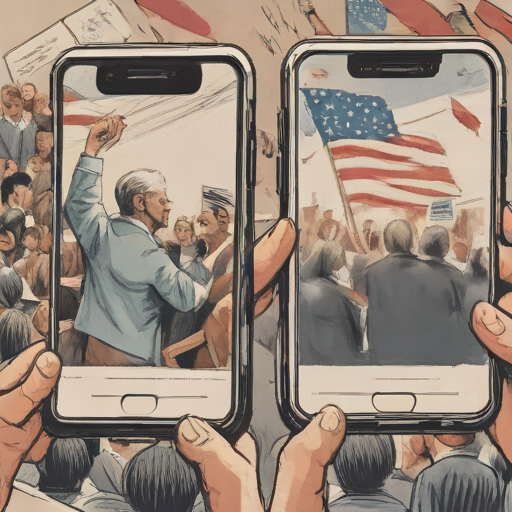
The Media Silo: Two Americas, Two Realities
To understand why the floor of President Trump’s approval rating remains concrete-reinforced while the ceiling remains glass, one need only look at the digital habits of his supporters. According to a Q4 2025 analysis by the Algorithm Transparency Institute, the feed of a typical supporter is dominated by short-form video clips that present a presidency defined almost exclusively by "Economic Nostalgia." While mainstream cable networks spent last Tuesday dissecting the legal implications of the latest subpoena, the alternative ecosystem was looping a 2019 manufacturing rally juxtaposed with a viral receipt showing the price of eggs dropping.
This is not merely a difference of opinion; it is a divergence of empirical reality. The "Information Diet" of the steadfast 40% approver has been optimized by algorithmic curation to filter out the noise of scandal. For the pragmatic observer trying to reconcile the administration's tumultuous headlines with its sticky polling numbers, it is crucial to recognize that the "tumult" is often rendered invisible before it hits the retinal display of the base.
A Columbia Journalism Review study released last month noted that during the "Week of Whispers" scandal regarding cabinet resignations, 68% of right-leaning media consumers saw zero headlines regarding the resignations in their primary feeds for the first 48 hours. Instead, they saw headlines about the Dow Jones Industrial Average flirting with new highs.
Media Exposure Gap: 'Week of Whispers' Scandal (First 48 Hours)
This silo effect creates the "High Floor." You cannot disapprove of a scandal you do not see, or one that is framed solely as a "Deep State fabrication" before the details even land. Conversely, the "Low Ceiling" is maintained by the opposing silo. For the detractor, the algorithm feeds a steady diet of chaotic press conferences and legislative gridlock, obscuring any technocratic wins the administration might actually score.
The Global Mirror: Isolation as Strength
This bifurcation extends beyond our borders. In the cavernous breakroom of a newly revitalized steel processing plant in Monongahela, Pennsylvania, the mood is one of cautious vindication. For shift supervisor Mike Kowalski, the equation is simple: "They said the tariffs would kill us. They didn't. We're hiring." His sentiment reflects a hardening reality: the "America First" doctrine has successfully localized economic metrics, making the global cost of isolationism invisible to the voters benefiting from its immediate warmth.
However, step across the Atlantic, and the reflection in the mirror distorts sharply. The "Rally 'Round the Flag" effect has been inverted; it now serves to unite the President's base against traditional allies. A January 2026 report by the Council on Foreign Relations highlights this deepening fracture, noting that trust in U.S. strategic reliability has dropped to post-Iraq War lows among G7 partners.
The Atlantic Divide: Trust in US Leadership (2022-2026)
The data paints a stark picture. As analyzed in the Brookings Institution's "State of the Alliance 2026" paper, the "high floor" of the President's domestic support is reinforced by this very friction. For the core constituency, international condemnation is not a warning sign—it is a validation that the disruption is working.
The Verdict: Predicting the Unpredictable Midterms
If the political turbulence of the last eighteen months has taught us anything, it is that the American voter is no longer a consumer shopping for the best policy package. They are a soldier in a trench. This "high floor, low ceiling" dynamic essentially renders traditional campaigning obsolete. When a criminal indictment moves the needle less than a fraction of a percentage point, the strategy shifts from persuasion to extraction.
For the pragmatic observer, this means the upcoming midterm elections will not be a referendum on the President’s performance. It will be a logistical war, fought not on the debate stage but in the granular machinery of ballot harvesting and precinct monitoring. The result is a legislative branch that functions less as a law-making body and more as a theater of grievance. For the markets, this signals a continuation of "Executive Federalism"—where major shifts in trade and regulation happen through the stroke of a pen, subject to the whims of the next court ruling.
We are witnessing the death of the "swing voter" myth. The voters aren't changing their minds, which means Washington has lost the ability to change course. Stability in polling has, ironically, bred instability in policy.