The Manchester Signal: Why Labour's Fracture Warns the American Left

A Winter of Discontent in the North
The letter arrived not with the fanfare of a press conference, but with the stark, bureaucratic thud of a digitally released PDF on a Tuesday morning—a Tuesday that was already struggling under the weight of an unyielding January frost. Signed by 50 Labour Members of Parliament, the document was ostensibly a critique of Greater Manchester Mayor Andy Burnham’s latest regional transit consolidation plan. But to the astute observer in Washington or Westminster, the text read less like a policy dispute and more like an indictment of the center-left’s defining strategy of the last half-decade.
Two years ago, the Labour party swept into power on a wave of disciplined unity, promising a "Big Tent" that could shelter both the metropolitan progressive and the post-industrial worker. That tent is now leaking freezing rain. The objection by these 50 MPs—a bloc significant enough to derail legislation in the House of Commons—marks the precise moment where the broad coalition ceased to be a strength and began to strain under the pressure of governance.
At the center of this storm stands Andy Burnham. To an American reader, Burnham is best understood not merely as a mayor, but as a British analogue to a powerful Governor of a "Rust Belt" state—a figure like Gretchen Whitmer or Josh Shapiro, who commands a personal brand distinct from, and occasionally antagonistic to, the national party apparatus. For years, Burnham has cultivated the image of the "King in the North," a champion for regions left behind by the capital's financial focus. Yet, the decision that triggered this revolt—a move to privatize elements of the Manchester transit data infrastructure in exchange for rapid modernization funding—has flipped the script.
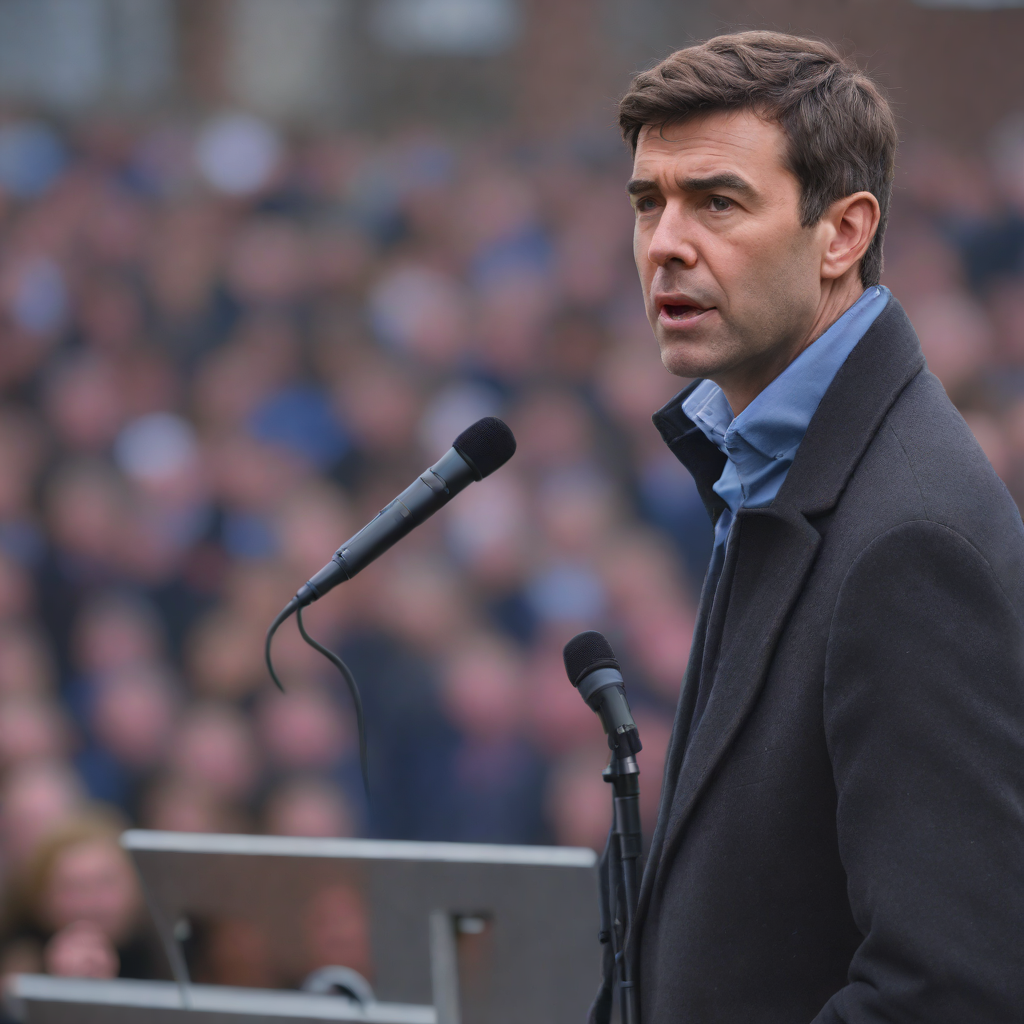
The signatories, hailing largely from the party’s traditional socialist wing and the newly won "Red Wall" constituencies, view this as a departure from public ownership principles. However, the conflict runs deeper than bus schedules or server farms. It exposes the fragility of a governing philosophy that attempts to marry pro-business efficiency with working-class redistribution without fundamentally altering the economic engine. Just as the Democratic coalition in the United States fractured over how to respond to the populist economic nationalism of the second Trump administration, the UK Labour government is finding that "competence" is no longer a sufficient substitute for ideological clarity.
The Anatomy of the Split
The rebellion of fifty Labour MPs against Andy Burnham’s "National Resilience Accord" is not merely a localized parliamentary skirmish; it is a seismic crack in the floorboards of the center-left’s global architecture. At its core, the split revolves around Burnham’s decision to prioritize industrial automation subsidies and 6G infrastructure over the preservation of traditional collective bargaining rights—a move he frames as a "techno-pragmatic" necessity to survive the hyper-competitive, deregulated trade environment of the second Trump administration. For the dissenting MPs, however, this isn't pragmatism; it is a surrender of the very soul of the Labour movement to the same market forces that fueled the populist surge of the mid-2020s.
The ideological fault lines are most visible in the "Green-Growth Paradox." While Burnham argues that the UK must match the US’s aggressive deregulation in energy sectors to keep manufacturing costs low, the rebel faction, led by the increasingly vocal Socialist Campaign Group, views this as a betrayal of the 2030 Net Zero targets. As a 2026 Chatham House analysis observes, "The centrist impulse to mimic the competitive 'anarchy' of Trump’s America creates an existential crisis for European parties that built their identity on the precautionary principle and social welfare." This isn't just about economics; it's about whether a center-left government can still exist if it adopts the tools of its rivals to stay relevant.
In the United States, this paralysis is mirrored in the Democratic Party’s struggle to find a coherent response to the "Adjustment Crisis." Just as Burnham faces backlash for his "Growth-at-all-Costs" pivot, American progressives find themselves at odds with party moderates who believe the only way to counter Trump’s isolationist tariffs is to embrace a similar "America-First" industrial policy. For a nurse like Elena Rodriguez in Phoenix, who saw her cost of living spike by an estimated 15% year-over-year—a figure she attributes to retaliatory trade wars, though economists also point to broader systemic supply chain failures—the distinction between the two parties is becoming dangerously blurred.
The "Big Tent" strategy, which sought to bridge the gap between suburban professionals and the industrial working class, is collapsing under the weight of these trade-offs. The data suggests a widening chasm between the party’s elite and its base regarding what "security" actually means in 2026.
Public Support for Economic Trade-offs (Source: 2026 Global Policy Monitor)
This divergence signals a critical failure of the center-left to articulate a vision that doesn't simply react to the populist right. By attempting to occupy the middle ground on issues like AI-driven labor displacement and civil liberty erosions in the name of "national security," they risk alienating the very voters who look to them for protection against the volatility of the age.
Mirror Image: The Squad and the Mayor
To the American observer, the rebellion in Westminster might feel like an unsettling case of déjà vu. The letter signed by 50 Labour MPs, challenging Andy Burnham’s concession to industrial deregulators, is not a uniquely British phenomenon; it is a transatlantic echo of the fracture currently paralyzing the Democratic Party in major American cities. Just as Burnham attempts to navigate the tightening fiscal noose of a post-Brexit economy, American mayors in "blue fortresses" like Chicago and New York are finding themselves besieged—not just by the Trump administration’s aggressively isolationist federal policies, but by their own ideological flanks.
The dynamic is virtually identical to the standoff witnessed last month in Chicago, where the Progressive Caucus nearly brought city governance to a halt over Mayor Brandon Johnson’s proposed "Fiscal Reality Budget." In both Manchester and Chicago, the executive branch—tasked with the pragmatic reality of keeping lights on and trains running—has collided with a legislative bloc unwilling to accept that the era of low-interest governance is over. The "Big Tent" strategy, which relied on the convenient fiction that pro-business growth and radical redistribution could coexist effortlessly, has collapsed under the weight of 2026’s economic harshness.
When Burnham argues that attracting foreign investment requires "painful flexibility" on labor standards, he sounds indistinguishable from California Governor Gavin Newsom, who recently infuriated environmental groups by fast-tracking exemptions for AI data centers to prevent them from fleeing to Texas. The 50 Labour MPs, much like "The Squad" in Washington, view this not as pragmatism, but as capitulation—a departure from the working-class mandate in favor of the very corporate interests that the populist right claims to fight.

The Cost of Governance
The letter signed by 50 Labour MPs, condemning Mayor Andy Burnham’s acceptance of the "partnerships for progress" private equity deal, reads less like a policy critique and more like an elegy for a political era that vanished two years ago. While the backbenchers frame the £2.4 billion infrastructure investment from a consortium led by US-based asset managers as a betrayal of the Bee Network’s public ethos, they are arguing against a rigid fiscal reality. The economic landscape of 2026, scarred by the "Great Fragmentation" of global trade and the crushing weight of sustained inflation, does not afford local leaders the luxury of ideological purity. The objection ignores the brutal arithmetic governing post-pandemic, high-inflation Britain: the central government in Westminster, paralyzed by its own debt servicing costs, has effectively turned off the tap for regional expansion.
To understand why Burnham moved, one need only look at the rusted stanchions of the Rochdale tram extension. For three years, the project sat half-finished, a monument to the funding gaps that have plagued the leveling-up agenda. For Sarah Jenkins, a nurse commuting from Oldham to the Manchester Royal Infirmary, the delay wasn't an abstract failure of neoliberalism; it was an extra forty minutes on a bus that often didn't show. "They talk about public ownership in London," Jenkins noted in a recent town hall, "but public ownership doesn't mean much if the public can't actually get to work." By securing private capital to complete the line, Burnham traded control for capacity, a transaction that the 50 dissenting MPs decry as a "slippery slope" to reprivatization. Yet, without this liquidity, the network—and the region's economic mobility—would have remained in a state of indefinite atrophy.
This disconnect mirrors the paralysis fracturing the Democratic coalition across the Atlantic. Just as the Labour rebels invoke the spirit of the 1945 manifesto to fight 2026 realities, the progressive wing of the US Democratic party continues to demand expansive federal programs that the current bond market simply will not finance. The "Big Tent" strategy relies on the assumption that a center-left government can satisfy both capital and labor through growth. But in a protectionist world defined by President Trump's aggressive tariff regime—which has already shaved an estimated 1.2% off UK GDP according to the Bank of England's latest quarterly report, a figure the Treasury fiercely disputes—growth is scarce. The "Burnham Decision" is an acknowledgement that when the pie shrinks, the only way to feed the constituent parts of the coalition is to invite the butcher to the table, even if he takes a cut.
The Populist Shark in the Water
While the Labour government attempts to contain the internal hemorrhage caused by the Burnham controversy, the true danger lies not in the parliamentary arithmetic of the rebellion, but in the signal it sends to the waiting opposition. The spectacle of 50 Labour MPs openly defying their leadership over regional economic pain has provided the perfect narrative fodder for a resurgent Right, which is already pivoting to capitalize on the fragmentation of the center-left coalition. This is no longer just a debate about municipal funding; it is being weaponized as proof that the "adults in the room" are incapable of governing without inflicting misery on their own base.
Reform UK, with its leadership recalibrating after the chaotic post-election period, has been swift to frame the dispute not as a policy disagreement, but as a betrayal of the working-class trust that Labour fought so hard to regain. They are deftly utilizing social media clips of the parliamentary discord, juxtaposing the "Westminster consensus" on austerity against the tangible struggles of Northern communities. As noted by political analysts at the London School of Economics in their Q4 2025 briefing, populist movements thrive on the perception of elite disconnect; when a Labour government is seen imposing "necessary pain" on its traditional heartlands, it effectively validates the populist argument that the entire political establishment—Left or Right—is indifferent to the plight of the common man.
Fractured Alliances in a Dangerous World
The rebellion of 50 Labour MPs against Andy Burnham’s directive is not merely a Westminster drama; for observers in Washington, it is the sound of the other shoe dropping. While the American news cycle is currently dominated by the logistical nightmares of "Railgate" and the cascading infrastructure failures exposed by the Minneapolis blizzard, the breakdown of political cohesion in London presents a quieter, yet arguably more insidious threat to American interests. The "Big Tent" strategy—the idea that a broad coalition could suspend ideological disagreements in favor of competence—has effectively collapsed, and with it, the reliability of America’s most critical bridge to Europe.
This internal fracturing translates directly into geopolitical risk. A confidential memo from the Atlantic Council, circulated among Senate aides this morning, explicitly warns that a Labour government consumed by factional warfare over domestic economic trade-offs is a government incapable of projecting power abroad. The logic is sound: if Burnham cannot whip votes for a domestic trade bill without sparking a revolt from the Campaign Group, he certainly cannot commit the UK to the high-cost, long-term defense spending required to sustain the Ukraine front as President Trump scales back American involvement. The "Special Relationship" has always relied on shared capacity, not just shared history. Today, that capacity is being eroded by the friction of internal dissent.
Ultimately, the objection by these 50 MPs signals that the era of cost-free consensus is over. The "Big Tent" hid the difficult choices between social spending and defense resilience, between free trade and protectionist industrial policy. By forcing these choices into the open without a mechanism to resolve them, the UK risks entering the same legislative paralysis that has plagued the US Congress. For the United States, this means the loss of a force multiplier. In a world defined by the consolidation of autocratic power, the inability of Western democracies to enforce party discipline is no longer just a matter of parliamentary procedure; it has become a first-order national security crisis.