Ground Stop: The Hidden Cost of Southwest’s Legacy Code
Blue Screen at 30,000 Feet
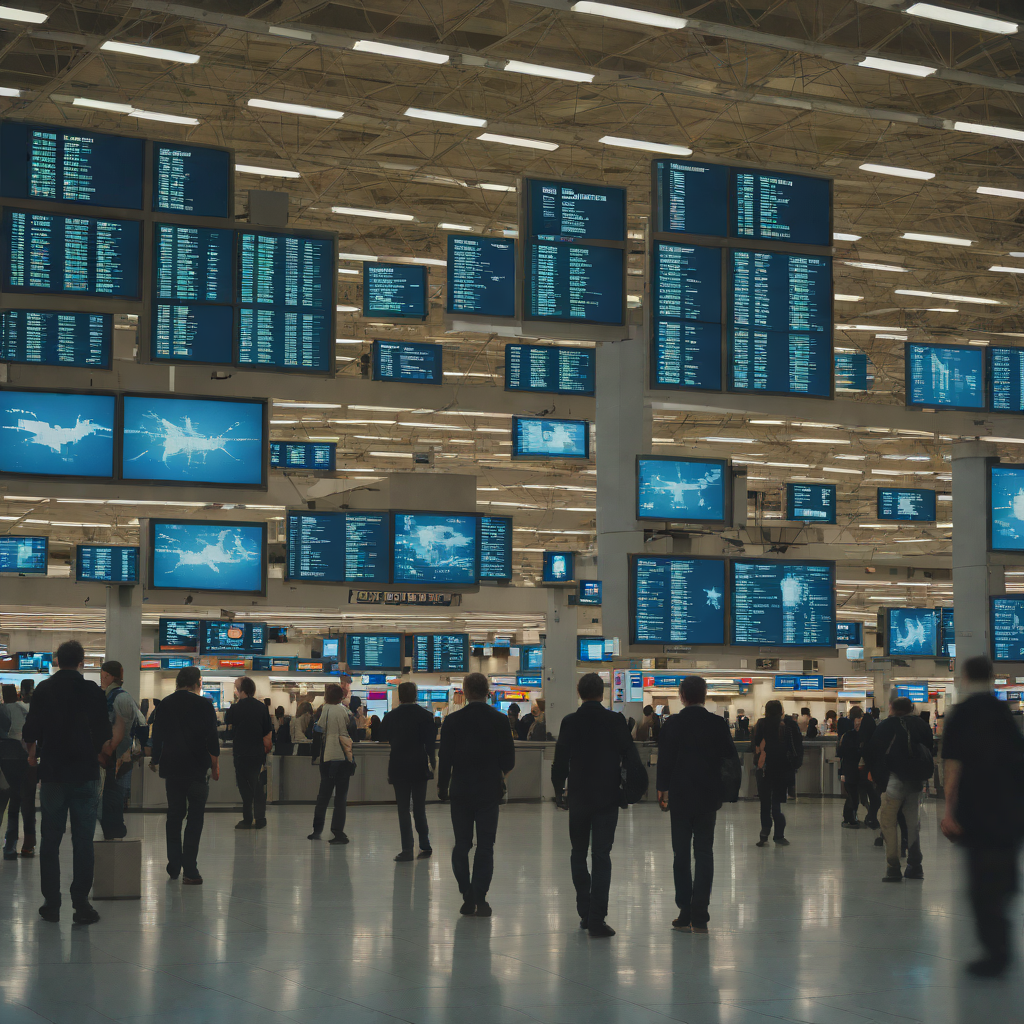
The announcement over the PA system at Dallas Love Field was almost clinical in its detachment: "We are currently experiencing a brief technology pause." But for the thousands of passengers stranded in Terminal B on this frigid Tuesday morning, the reality was anything but brief. It was a chaotic tableau of the American travel experience in 2026—families sleeping on linoleum floors, business travelers frantically rebooking on satellite connections that were themselves overloaded, and the distinct, rising humidity of a crowd pushed to its breaking point. The monitors simply displayed the dreaded "blue screen," a glowing azure tombstone for the day’s flight schedule.
This scene has become a grimly reliable ritual in American aviation. While carriers often dismiss these events with the anodyne label of "temporary technical difficulties," the frequency of these failures points to a far more structural rot. In an era where the second Trump administration’s "Deregulation First" doctrine has emboldened corporations to slash operational overhead, the invisible backbone of our transportation network—the software—has been left to rust. We are attempting to run a 2026 economy, powered by nascent 6G networks and AI-driven logistics, on mainframe architecture that has its roots in the Reagan era.
The disconnect is jarring. Southwest Airlines, once the darling of efficiency, now finds itself the poster child for this infrastructure fragility. Following the catastrophic meltdown of late 2022, promises were made to overhaul the scheduling systems that famously lost track of crews during winter storms. Yet, here we are, four years later, grounded by what insiders describe as a "patchwork quilt of legacy code" buckling under the sheer velocity of modern demand. It is a crisis of technical debt that no amount of cost-optimization can hide. When a single router failure in a server farm can ground a fleet across four time zones, we aren't looking at a computer glitch; we are looking at the systemic fragility of a superpower that has neglected its foundation for too long.
The Ghost of Meltdowns Past
To understand why thousands of passengers are currently stranded across the Midwest, sleeping on terminal floors from Chicago Midway to Denver International, one must look back to the ghosts of Christmas 2022. The chaotic scenes unfolding this week—the "blue screens of death" at departure gates and the eerie silence of unassigned cockpits—are not a new anomaly. They are the predictable aftershocks of a seismic fault line that was identified four years ago but never truly reinforced. When the Department of Transportation fined Southwest $140 million in 2023, the assumption was that the check marked the end of the era of fragility. Instead, industry analysts argue it merely marked the price of doing business without fundamental reform.
The narrative sold to shareholders in 2024 and 2025 was one of "modernization" and "digital transformation." Yet, insiders describe a different reality: a "patchwork" strategy where sleek, customer-facing mobile apps were built atop crumbling backend foundations. The core crew scheduling systems—the digital nervous system responsible for matching pilots and flight attendants to planes—remain tethered to architecture from the 1990s. In the high-stakes environment of 2026 aviation, where AI-driven dynamic routing is becoming the standard for competitors like Delta and United, maintaining legacy code is akin to running a hyperloop train on rusted iron tracks.
This technical stagnation did not happen in a vacuum. While the roots of this debt stretch back decades, the shifting regulatory soil of the last twelve months has hardened the ground against reform. The Trump administration’s swift moves to dismantle what it termed "burdensome bureaucratic oversight" in the transportation sector effectively removed the external pressure for major carriers to overhaul their internal systems. The "Efficiency First" executive order signed last year encouraged carriers to self-regulate their technology upgrades. For airline executives facing pressure to recover post-pandemic margins, the choice was mathematically simple: allocate capital to fleet expansion and stock buybacks rather than the invisible, unglamorous work of refactoring millions of lines of code.
The Resilience Gap: Fleet Growth vs. IT Core Investment (Index 2021=100)
The data paints a stark picture of diverging priorities. While Southwest aggressively expanded its fleet to capture post-recession travel demand, creating a more complex network web, the investment in the 'digital concrete' to support that web faltered. Echoing warnings raised by the Southwest Airlines Pilots Association (SWAPA) during the 2022 crisis, which cautioned that the carrier was held together by "duct tape and baling wire," a recent internal assessment warned that the "technical debt ceiling" had been reached. They predicted that a "compound stressor"—like the severe winter storm currently freezing Minneapolis—would result in a cascade failure not unlike the 2022 meltdown.
The Efficiency Paradox
In the boardrooms of Dallas, much like those in Chicago and Atlanta, the mandate for the fiscal year 2025 was clear: maximize the "Trump Bump." As the administration slashed corporate tax rates and dismantled what it termed "regulatory sludge" under the American Competitiveness Act of 2025, airlines found themselves flush with capital. However, a forensic look at SEC filings reveals that this liquidity did not flow into the digital veins of the aviation network. Instead, it was funneled into the hands of shareholders. The collapse of Southwest’s scheduling integrity is not merely a failure of code, but a failure of capital allocation driven by the market’s obsession with short-term efficiency over long-term resilience.
The incentives are perverse but rational within the current regulatory vacuum. Under the renewed "light-touch" oversight of the Department of Transportation, the pressure to upgrade legacy systems—the digital equivalents of rusting bridges—has evaporated. Without the threat of heavy fines for operational failures, the cost-benefit analysis shifts. Why spend $500 million on a risky, multi-year migration from 1990s mainframe architecture when you can patch it for $50 million and use the difference to fuel a stock buyback program? This is the "Efficiency Paradox": in stripping away the redundancy required for safety and stability to achieve leaner margins, the system becomes brittle. When a stressor hits—be it a blizzard in Minneapolis or a crew displacement in Denver—the optimized system shatters because it lacks the slack necessary to absorb the shock.
Wall Street analysts have rewarded this behavior. Throughout late 2025, carrier stocks rallied on promises of "operational leanness" and "margin expansion." Yet, this financial engineering masks a technological rot. Industry insiders point to a widening gap between front-end user experience—slick apps, biometric boarding, AI chatbots—and the backend reality. We are flying on 2026 jets coordinated by 1996 software. The deregulation agenda, designed to unleash American business, has inadvertently incentivized the deferral of critical maintenance. It is a gamble that assumes clear skies forever, ignoring the increasing volatility of both climate and complex systems.
Industry Total: Buybacks vs. IT Infrastructure (Billions USD)
The data paints a damning portrait of this divergence. As shown in the sector-wide analysis above, while expenditure on stock repurchases has skyrocketed following the 2025 tax incentives, capital expenditure on IT infrastructure has stagnated or declined in real terms. We have effectively financialized the reliability of our transport network, trading the certainty of arrival for the certainty of quarterly returns.
When Legacy Meets AI
The error message that flashed across the screens of Southwest’s Network Operations Control in Dallas was not a hallucination of a rogue AI, but a timeout from a system older than many of the pilots currently in the air. While the carrier’s new "Dynamic Optimization Agent"—a proprietary AI module rolled out to much fanfare in late 2025—was successfully calculating a million potential crew rerouting options per second, the underlying crew scheduling database, built on 1990s architecture, simply could not write the changes fast enough. It is a phenomenon enterprise architects are calling "chronological friction": the violent shuddering that occurs when millisecond-latency AI logic attempts to interface with batch-processing mainframes designed for a slower era.
This technical mismatch is the direct, invisible consequence of the "patch-over-replace" strategy that has come to define American aviation infrastructure under the current regulatory environment. Following the "AI Competitiveness Executive Order" signed by President Trump in early 2025, which streamlined safety certifications for "logistical and non-safety-critical" software, carriers were incentivized to deploy AI layers rapidly to cut costs. The logic was seductive: why spend $1 billion and five years ripping out the foundational "spaghetti code" when an API wrapper and a machine learning model could theoretically deliver the same efficiency gains in six months? The result, as evidenced by this week’s operational paralysis, is a digital facade that looks modern but stands on shifting sand.
The friction is measurable. According to leaked internal reports, the discrepancy between the AI’s "instruction rate" and the legacy system’s "execution rate" created a backlog of 40,000 unverified transaction logs during the peak of the storm. The AI, seeing that its orders weren't being confirmed, entered a recursive loop, re-issuing the same rerouting commands until the legacy servers effectively suffered an internal denial-of-service attack. This wasn't a failure of artificial intelligence; it was a failure of the physical reality to keep up with synthetic speed. As noted in the Department of Transportation's Inspector General report from Q4 2025, over 60% of major US carriers rely on core scheduling systems that date back to the pre-cloud era, creating a "resilience gap" that widens with every software update.
The Erosion of Trust
For the average American traveler in 2026, the promise of "low fares, nothing to hide" has curdled into a gamble against probability. Standing in the crowded terminal of Harry Reid International, staring at a board of cancellations, the frustration is no longer just about a missed connection; it is a realization that the social contract of reliable affordable travel has fractured. The recurring ground stops and system outages plaguing Southwest Airlines are not merely operational hiccups but the visible cracks in a transportation model that has failed to modernize while the world around it accelerates.
The competitive landscape of 2026 has shifted aggressively. While Southwest wrestles with crew scheduling software that dates back to the pre-smartphone era, the consumer’s alternative set has expanded. The partially completed Brightline West corridor, promising high-speed rail connectivity between Las Vegas and Southern California, looms as a tangible threat to the airline’s short-haul dominance. Simultaneously, the proliferation of autonomous transit corridors in the Sun Belt offers a new value proposition: a predictable, if slower, journey free from the chaotic uncertainty of the tarmac. For the budget-conscious traveler, the calculation has changed. If a flight is as likely to be canceled as it is to depart, the four-hour autonomous drive or the premium rail ticket begins to look less like a luxury and more like an insurance policy against dysfunction.
This erosion of trust is exacerbated by the current deregulation drives in Washington. With the Department of Transportation under the second Trump administration rolling back the aggressive "passenger bill of rights" initiatives of the previous term, the safety net for stranded passengers has frayed. A delayed flight in 2026 doesn't just mean lost time; without guaranteed compensation mandates, it often means out-of-pocket expenses that obliterate the savings of a budget ticket. The consumer is left holding the bag for the airline’s technical debt.
Turbulence Ahead
The persistent blackouts in Southwest Airlines’ point-to-point scheduling system throughout January 2026 are no longer "unprecedented"—they are the predictable output of a systemic gamble. For the millions of travelers stranded from Dallas-Love Field to Chicago-Midway, the "glitch" has become a permanent feature of the American travel experience, a ghost in the machine that first manifested in the holiday meltdown of 2022 and has since calcified into a structural rot. As the second Trump administration accelerates its "Efficiency First" initiative, the repeal of consumer protection mandates has shifted the calculus for legacy carriers: it is now mathematically cheaper to apologize for a collapse than to prevent one.
The crisis at Southwest is a microcosm of a broader national decay where the "just-in-time" philosophy of the 20th century meets the deregulation fervor of 2026. A 2025 white paper from the Brookings Institution warned that the US aviation backbone—much like the rail lines currently paralyzed by the "Railgate" scandal—is operating on software layers that haven't seen a fundamental rewrite since the Clinton administration. In the boardrooms of North Texas, the decision to prioritize short-term dividends over the grueling, multi-billion-dollar task of technical debt remediation is not an error in judgment; it is a rational response to a regulatory environment that no longer penalizes failure.
Projected Capital Allocation 2026 (Billions USD)
This divergence between shareholder reward and operational resilience has created a fragile equilibrium. While the administration argues that slashing "red tape" will spark a new era of American industrial hegemony, the reality on the tarmac suggests otherwise. Transportation policy makers now face a stark binary: continue the 2026 pivot toward unchecked corporate autonomy, or recognize that essential infrastructure requires a floor of stability that the market, left to its own devices, is increasingly unwilling to fund. For the business traveler whose "autonomous" 2026 flight was canceled by a 1995-era scheduling loop, the choice between resilience and profit is no longer academic—it is the difference between arriving and remaining stuck.