The Last Witnesses: King Charles Shields History From Digital Erasure
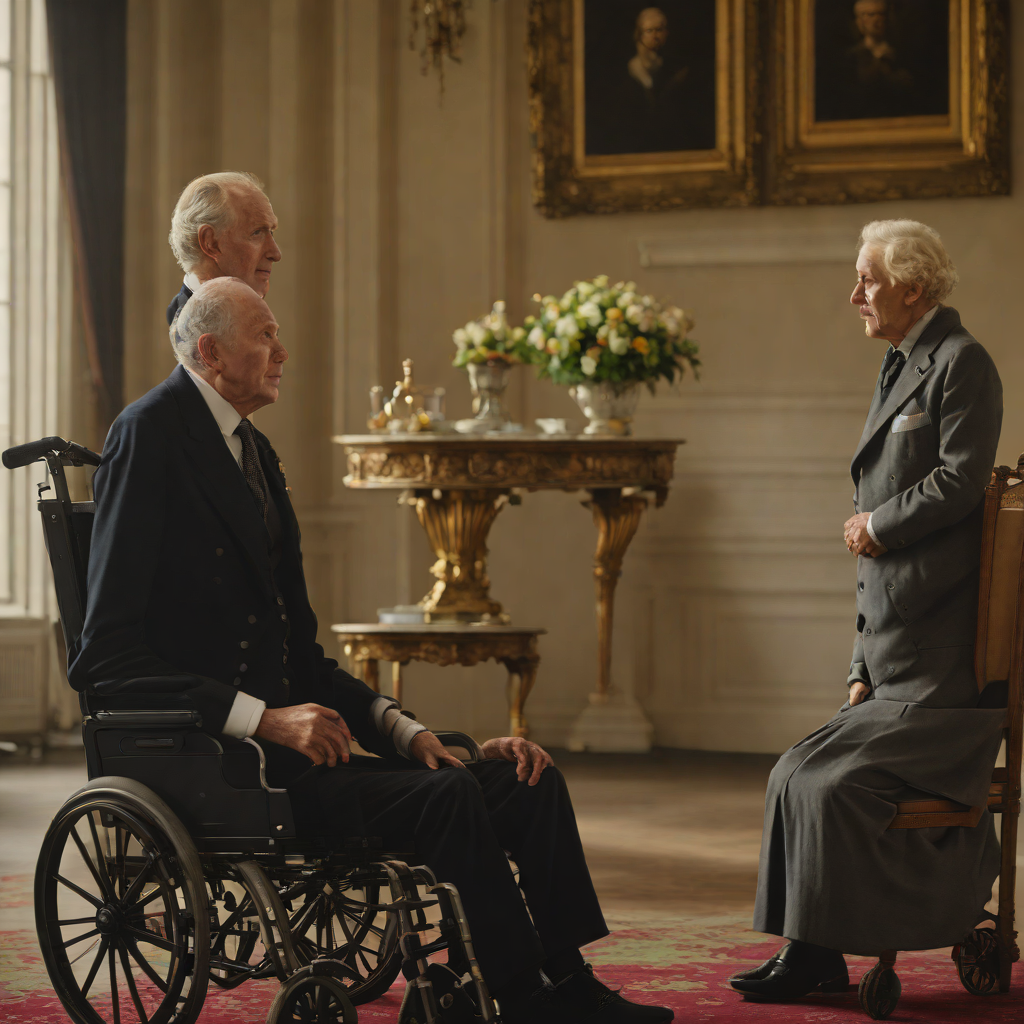
In the opulent silence of the 1844 Room at Buckingham Palace, the squeak of a rubber wheelchair tire on the parquet floor sounded louder than a trumpet blast. It was Tuesday afternoon—Holocaust Memorial Day—and the contrast could not have been more stark: the enduring, gilded permanence of the British monarchy meeting the fragile, fading reality of the last living witnesses to the twentieth century’s greatest crime.
King Charles III, wearing a somber dark suit rather than ceremonial uniform, moved with deliberate, quiet deference among the small group. This year’s reception felt markedly different from those of the past decade. The group is smaller, their movements slower, their voices softer. When the King grasped the hand of a 98-year-old survivor—who had traveled from North London despite failing health—it was not merely a ceremonial greeting but an act of archival preservation. In the absence of figures like the late Manfred Goldberg, who passed in late 2025, the burden of testimony was visibly shifting from the individual to the institutional.
A Sovereign's Personal Pledge
For King Charles, the obligation of remembrance has never been a mere entry in the court circular; it is a hereditary imperative deeply entwined with his own family history. His commitment is rooted in the legacy of his grandmother, Princess Alice of Battenberg, who was recognized as 'Righteous Among the Nations' for sheltering a Jewish family in Nazi-occupied Athens. This familial link creates a bridge between the British Crown and the darkest chapter of the 20th century, granting the King a unique moral authority that transcends political cycles.
While politicians in Washington and London navigate the volatile currents of the current 'America First' isolationism and shifting alliances, the King’s stance remains immutably fixed on the lesson of "Never Again." This stability offers a stark contrast in a republic where institutional trust has fractured—evidenced by the deep polarization characterizing the second Trump term. It raises a pertinent question for the democratic West: when the last survivor passes, who will assume the mantle of the witness?
The Rising Tide of Revisionism
The urgency of this royal engagement is underscored by a terrifying data landscape. The Anti-Defamation League’s audit of 2024 incidents documented a record-breaking 9,354 antisemitic acts in the United States alone. While 2025 data is still being finalized, preliminary indicators suggest the trend has not abated. For a US audience grappling with the boundaries of free speech and the rise of sectarian violence, these numbers represent more than just hate crimes; they signal a breakdown in the collective immune system of civil society.
US Antisemitic Incidents: A Five-Year Escalation (Source: ADL Audit)
However, the threat has mutated. Beyond physical intimidation, the survivors in the room face a new, spectral enemy: digital revisionism. Recent monitoring data from the Institute for Strategic Dialogue suggests that online denialism is morphing into algorithmically amplified revisionism, targeting a generation that lacks direct connection to the events of the 1940s.
The Digital Threat to Memory
The silence left by the passing of the last survivors is being rapidly filled by a cacophony of digital noise. In the "Trump 2.0" era internet, where deregulation is the guiding philosophy for social platforms, the line between free speech and hate speech has effectively dissolved. The algorithms that drive engagement on platforms like X (formerly Twitter) and the emerging decentralized networks often amplify conflict over consensus.
For Sarah Miller (pseudonym), a 34-year-old educator in suburban Philadelphia, the threat is no longer just the occasional swastika graffitied on a synagogue wall, but the pervasive algorithmic rewriting of history her students encounter daily. "They see videos claiming the gas chambers were logistical impossibilities," Miller notes, referencing a viral strain of pseudo-documentaries that surged in late 2025. "These aren't dark web corners anymore; they are in the main feed, sandwiched between gaming highlights and influencer vlogs."

Generative AI tools have made the creation of "evidence" for non-existent events—or the erasure of documented ones—trivial. This creates a "truth arbitrage" where sensationalist, algorithm-pleasing fiction travels faster and is more profitable than the sober, uncomfortable reality of genocide. In this context, the physical presence of the Head of State serves as a form of "human blockchain"—a centralized, verifiable witness to the witnesses.
A Covenant for the Future
The meeting at Buckingham Palace was defined less by pomp than by a palpable sense of urgency. As the era of the "living witness" ends, the burden of remembrance shifts decisively from the frail shoulders of survivors to the institutional memory of the state. The King did not speak of the Holocaust as a closed chapter of history, but as a living warning—a necessary admonition in a year where global fault lines are widening.
By institutionalizing remembrance within the continuity of the Crown, the UK is attempting to anchor historical truth outside the turbulent cycles of partisan politics. The "covenant" established in London yesterday acknowledges that future generations will not have the privilege of hearing these stories from the source. Instead, they will rely on the integrity of archives, the rigor of education, and the steadfastness of public institutions to distinguish fact from fabrication. As the voices of the last survivors fade, the silence they leave behind must not be filled by the noise of revisionists, but by the resolute, institutional defense of historical truth.