The Atlantic Fracture: London's High-Wire Act Between Trump and Beijing

The Desperate Search for Growth
The promise of "Global Britain"—the sunlit uplands of sovereign prosperity heralded during the Brexit referendum—has collided violently with the cold, hard mathematics of 2026. Ten years after the vote to leave the European Union, the United Kingdom finds itself in an economic straitjacket of its own making, exacerbated by a geopolitical landscape that has shifted beneath its feet. With the European single market largely gated behind red tape and the "Special Relationship" with the United States straining under the weight of President Trump’s "America First" protectionism, London is running out of options. The resulting pivot is as pragmatic as it is perilous: a quiet, desperate courtship of Beijing.
The numbers tell a stark story of stagnation. According to the Bank of England's Q4 2025 Monetary Policy Report, UK productivity growth has flatlined, hovering near 0.4% annually—a figure that barely keeps pace with inflation, let alone funds the National Health Service or modernizes aging rail infrastructure. For the average British business, this macroeconomic paralysis is not abstract; it is an existential threat. Take the case of James Thorne (a pseudonym), a specialized components manufacturer based in the West Midlands. For decades, his firm supplied aerospace parts primarily to American contractors. However, the implementation of the Trump administration's "Universal Baseline Tariff"—levying a 10% duty on all foreign imports regardless of alliance—has effectively priced his goods out of the US market.
"We were told that leaving the EU would open up the world, specifically a comprehensive trade deal with Washington," Thorne explains, his factory floor quieter than it has been in twenty years. "Instead, we are facing the same barriers as hostile nations. The Americans aren't buying, the Europeans are too expensive to sell to, and my order book was empty until the inquiries started coming from Shenzhen." Thorne’s dilemma mirrors the national crisis: when the traditional engines of Western commerce stall, the gravity of the Chinese market becomes inescapable.
This pivot is not born of ideological alignment but of sheer survival. While the White House doubles down on decoupling, pressuring allies to strip Chinese technology from their supply chains, the British Treasury is quietly signaling that business is open. A recent analysis by the Financial Times highlights that despite political rhetoric, UK imports of Chinese electric vehicles and green energy infrastructure jumped by 18% in late 2025. The logic is brutal but simple: China offers the capital and affordable goods necessary to jumpstart the British economy, commodities that a protectionist America is no longer providing on favorable terms.
The political optics, however, are explosive. By deepening economic ties with China to stave off recession, the UK risks looking like the weak link in the NATO alliance. Former President Biden’s administration had already warned London against "having its cake and eating it too," but the Trump White House views such hedging not just as diplomatic indecision, but as a betrayal. As US Trade Representative Robert Lighthizer’s successor recently noted in a scathing op-ed for the Wall Street Journal, "Allies who feed the dragon cannot expect shelter under the eagle's wing." Britain is thus walking a razor's edge, forced to gamble that it can absorb Chinese investment to fuel growth without triggering a retaliatory decoupling from its oldest, and increasingly volatile, security partner.
UK Trade Volume: The Pivot to Asia (2020-2025)
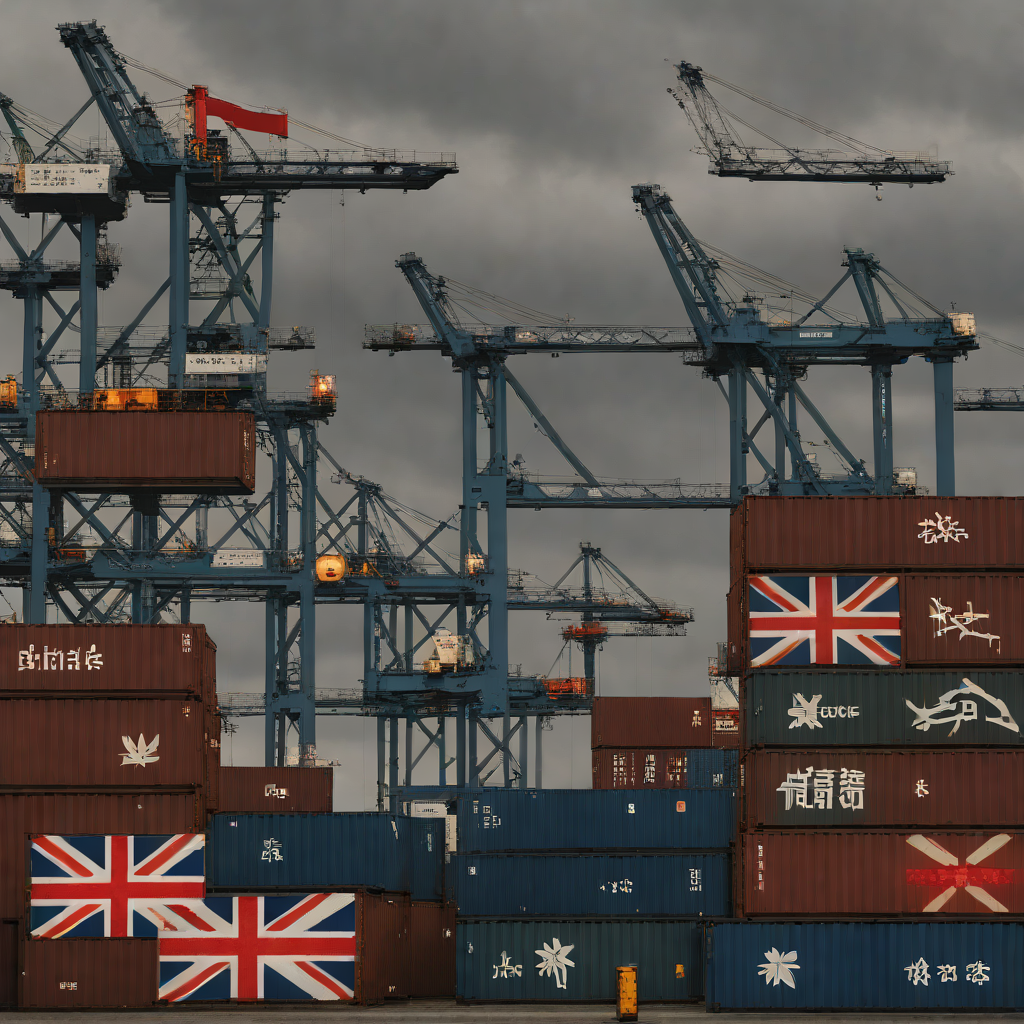
Reopening the Silk Road
London’s financial district is quietly buzzing with a phrase that hasn't been heard in earnest since the early 2010s: "The Golden Era." But unlike the public pageantry of the Cameron years, this renewed courtship of Beijing is happening in the shadows, driven by a post-Brexit economic reality that has become impossible to ignore. With the Trump administration’s 10% universal baseline tariff hammering British exports to the United States—a blow estimated by the Confederation of British Industry (CBI) to cost the UK economy £20 billion annually, a projection broadly supported by independent analysis from the Institute for Fiscal Studies (IFS)—Whitehall has been forced to reopen the Silk Road, albeit through the back door.
The strategy, described by insiders as "strategic compartmentalization," aims to ringfence specific sectors of the UK economy from the brewing US-China trade war. The goal is to deepen ties with China in areas that ostensibly pose no national security threat to the United States, thereby dodging the ire of an "America First" White House. "We are walking a tightrope in a hurricane," admits a senior trade official at the Department for Business and Trade, speaking on condition of anonymity. "The objective is to sell Ferraris and financial derivatives to Shanghai, not semiconductors or surveillance tech. We are betting that President Trump won't care about luxury handbags."
This gamble is evident in the recent, low-profile trade mission led by junior ministers to the Guangdong-Hong Kong-Macao Greater Bay Area. While Washington was busy enforcing new export controls on quantum computing components, British delegates were in Shenzhen securing market access for UK service providers. The City of London, desperate for liquidity after being locked out of European markets and squeezed by New York's deregulation, sees China's capital controls as a lock they are uniquely positioned to pick. Data from the City of London Corporation suggests that renminbi clearing volumes in London have ticked up 15% in the last quarter alone, a signal that financial plumbing is being laid even as political rhetoric remains frosty.
However, the definition of a "safe" sector is becoming increasingly fluid. The UK is heavily promoting its green technology expertise to Beijing—specifically in offshore wind and carbon capture—arguing that this is climate cooperation, not tech transfer. Yet, in the eyes of the Trump administration, energy independence is national security. A 2025 report by the Heritage Foundation explicitly warned allies that "green dependencies" on China would be treated with the same severity as 5G network integration. By pursuing Chinese investment for its Net Zero infrastructure, Britain risks crossing a red line that Washington has already drawn in thick, permanent marker.
For American observers, the irony is palpable. The "Special Relationship" is being tested not by a divergence in military values, but by a divergence in economic survival strategies. While the US economy, insulated by its vast internal market and energy dominance, can afford to decouple, the UK cannot. Michael Johnson, a sovereign risk analyst at a New York-based firm, notes the precariousness of the British position: "London is trying to thread a needle that doesn't exist. They assume they can take Chinese money for infrastructure and American protection for defense. In 2026, those two ledgers are merged. Every pound of trade with China is a political debit in Washington."
Projected UK Export Growth by Destination (2026-2027)
The visual disparity in growth projections highlights the sheer gravitational pull of the Chinese market for a stagnating British economy. If the "Service Sector Focus" delivers nearly 7% growth while trade with the US contracts, the political will in Westminster to defy Washington will only harden. The question remains how long the Trump White House will tolerate this economic hedging before declaring that in the new Cold War, there is no such thing as a neutral merchant.
Washington's Glare
Inside the West Wing, the sentiment regarding the United Kingdom’s recent diplomatic overtures to Beijing is neither subtle nor sympathetic. President Trump’s second term has been defined by a transactional realism that views traditional alliances not as sacred covenants, but as balance sheets subject to daily audit. For the administration, Downing Street’s attempt to court Chinese foreign direct investment while sheltering under the American security umbrella is seen as a fundamental breach of contract. A senior National Security Council official, speaking on condition of anonymity, described the mood in the Oval Office as "exasperated," noting that the President views the UK's dual-track diplomacy as an attempt to "have their cake and eat our lunch."
This frustration has rapidly crystallized into policy. The Office of the United States Trade Representative (USTR) has already drafted preliminary schedules for what are termed "integrity tariffs"—levies designed specifically to penalize allies who backfill the voids left by American sanctions on China. The message delivered to the British ambassador in Washington was reportedly stark: if British ports become a backdoor for Chinese EVs and advanced manufacturing components to bypass the 'America First' wall, the United States will treat British exports with the same hostility reserved for Shenzhen. The threat is not theoretical; the administration has explicitly linked the renewal of the US-UK dormant trade talks to a complete alignment on semiconductor export controls, effectively demanding London surrender its economic sovereignty in the tech sector.
The chilling effect is already visible on K Street. Lobbyists for major British financial institutions, once treated as cousins in the capital, now find themselves navigating a hostile environment where access is contingent on disavowing Asian entanglements. The Treasury Department has begun quiet inquiries into the exposure of London-based banks to Chinese real estate debt, signaling a potential weaponization of the SWIFT system against "systemic enablers" of the rival superpower. For Washington, the "Special Relationship" is no longer a historical inevitability; it is a leverage point. As the White House Press Secretary bluntly stated during a briefing last week, "Friendship in 2026 is measured by who stands with us in the trenches of the economic war, not who sells supplies to the other side." The gamble for Britain is existential: in trying to stabilize its economy with Eastern capital, it risks severing the Western artery that sustains its geopolitical relevance.

The Technology Trap
The quiet hum of the Cambridge Science Park belies the geopolitical storm brewing within its glass-walled laboratories. For years, this fenland cluster has been the jewel of Britain’s innovation economy, a testament to the country's ability to punch above its weight in global R&D. But in early 2026, the atmosphere is less about breakthrough discovery and more about existential survival. The reason lies in a seemingly innocuous component: a next-generation graphene sensor designed for monitoring electric vehicle battery efficiency.
For James Sterling (pseudonym), the CEO of a mid-sized semiconductor packaging firm based in the park, the dilemma is arithmetic, not ideological. "We need capital to scale production," Sterling explains, gesturing to a floor of idle machinery. "London's venture markets are risk-averse, frozen by the post-Brexit liquidity crunch. The only serious term sheet on my desk is from a consortium based in Shenzhen."
This is the precise mechanism of the trap. The British government, desperate to ignite growth and justify its "Global Britain" mandate, has quietly encouraged these partnerships, framing them as purely commercial engagements in "benign" sectors like green energy or consumer electronics. Trade data from the Office for National Statistics reveals a 14% uptick in UK-China technology joint ventures over the last fiscal year, a figure that Downing Street touts as a victory for open markets. However, in Washington, the view from the Trump White House is radically different.
To the hawks in the current US Department of Commerce, there is no such thing as a "benign" technology sector when China is involved. Under the Trump administration’s expanded interpretation of the Foreign Direct Product Rule (FDPR)—revised aggressively in late 2025—the definition of "dual-use" technology has swallowed entire industries. What Sterling sees as a battery monitor, the Pentagon sees as a thermal regulation system for swarming drones.
The friction is already generating sparks. Last month, a Liverpool-based optics manufacturer found its access to the US market suspended overnight. The trigger wasn’t a weapons deal, but the acceptance of a minority stake from a Shanghai-based equity fund. The message from Washington was brutal in its simplicity: choose your capital, choose your market. You cannot have both.
This places Whitehall in an excruciating vice. Blocking Chinese investment risks pushing British tech firms into insolvency, hollowing out the very industries promised to replace financial services as the engine of the economy. Yet, permitting it invites the wrath of an "America First" administration that views economic statecraft as a zero-sum game. The Special Relationship is no longer a shield; it is a leverage point.
A confidential report circulating within the UK’s Department for Business and Trade, leaked to The Times earlier this week, warns that if the US applies Section 301 tariffs to British tech exports containing "adversarial capital," it could wipe £12 billion off the UK economy in a single quarter. The report starkly concludes that Britain is "sleepwalking into a binary choice between solvency and security."
The Capital Chasm: Source of New Tech Investment in UK (2023-2026)
The chart above illustrates the dangerous divergence. As US venture capital retreats—spooked by the regulatory uncertainty and the UK’s sluggish growth—Chinese capital has surged to fill the void. This is not merely an economic shift; it is a structural realignment of loyalty that no amount of diplomatic rhetoric can mask. When a British CEO looks at their balance sheet, they see Beijing offering a lifeline and Washington threatening a blockade.
The "Technology Trap" is therefore not about the technology itself, but about the invisible lines of sovereignty being drawn through circuit boards and server racks. By pursuing necessary trade with China to keep the lights on, Britain risks tripping the wires of an American security apparatus that has stopped distinguishing between a competitor and an enemy. The question is no longer whether Britain can balance these two giants, but how long it can survive the stretch before it breaks.
A Fracture in the Atlantic
The diplomatic cables exchanged between London and Washington this winter carry a chill that has nothing to do with the freezing temperatures gripping the Potomac. For decades, the "Special Relationship" was the bedrock of transatlantic security—an automatic alignment of interests that survived the Suez Crisis, the Cold War, and the War on Terror. However, as the Trump administration enters the second year of its second term, that bedrock is showing hairline fractures. The White House’s uncompromising "America First" doctrine, which demands total economic decoupling from Beijing, is colliding head-on with a harsh British reality: a post-Brexit economy that simply cannot afford to sever ties with its second-largest import partner.
This divergence is not merely rhetorical; it is measured in the silent attrition of trade deals that never materialized. While Downing Street publicly champions the Atlantic alliance, the ledger tells a different story. Facing stagnant growth and a cost-of-living crisis that has outlasted the previous government, British policymakers are quietly carving out a "pragmatic engagement" strategy with China—seeking investment in green energy and infrastructure. To the current Oval Office, this looks less like pragmatism and more like betrayal. A senior trade advisor in the Trump administration, speaking on condition of anonymity, described the UK’s stance as "trying to have their cake and eat it, while we pay for the bakery," signaling that the era of sentimental exemptions for the UK is effectively over.
The human cost of this geopolitical standoff is already visible in the supply chains of American businesses dependent on British imports. Consider the case of David Miller, a specialized electronics importer based in New Jersey. For fifteen years, his firm has integrated high-precision sensors manufactured in the English Midlands into security systems sold across the United States. "We used to clear customs in hours," Miller explains, pointing to a backlog of shipping manifests. "Now, because our British suppliers use a specific sub-component from Shenzhen, we are flagged. We are being told to choose: find a new supplier or pay the 'China-linked' tariff surcharge." His struggle illustrates a broader trend confirmed by the U.S. Chamber of Commerce’s early 2026 outlook, which warns that "origin-washing"—the practice of rerouting Chinese goods through third-party countries—will be met with the most aggressive enforcement in customs history.
Projected Impact of 'China-Linked' Tariffs on US-UK Trade Volume (2024-2027)
The strategic drift is perhaps most acute in the technology sector, where the "digital border" is hardening. While the EU has responded to American pressure by erecting its own privacy and antitrust walls, the UK has attempted to position itself as a nimble, deregulation-friendly bridge between East and West. Yet, in 2026, bridges are dangerous places to be. The Trump administration’s recent executive order on "Secure Supply Chains for Critical Industries" effectively blacklists any ally that integrates Chinese 6G standards into their national grid. If London proceeds with its tender for next-generation infrastructure—where Chinese bids are currently 30% cheaper than their Western counterparts—it risks being cut off from the American intelligence-sharing ecosystem that has defined the Five Eyes alliance for nearly a century.
Ultimately, the Special Relationship is transitioning from a partnership of shared values to a transaction of aligned interests. The sentimental capital accumulated since World War II is being spent, replaced by a cold calculus in Washington that views allies through the singular lens of the China containment strategy. For the United Kingdom, the gamble is existential: can it maintain its economic sovereignty by trading with the East, without finding itself locked out of the West? As the tariffs bite and the diplomatic language hardens, the evidence suggests that the Atlantic is becoming wider, and colder, than it has been in living memory.