The Shattered Pact: How Railgate and the Death of Alex Pretti Exposed America's Fragility
Blood on the Ice: The Minneapolis Spark
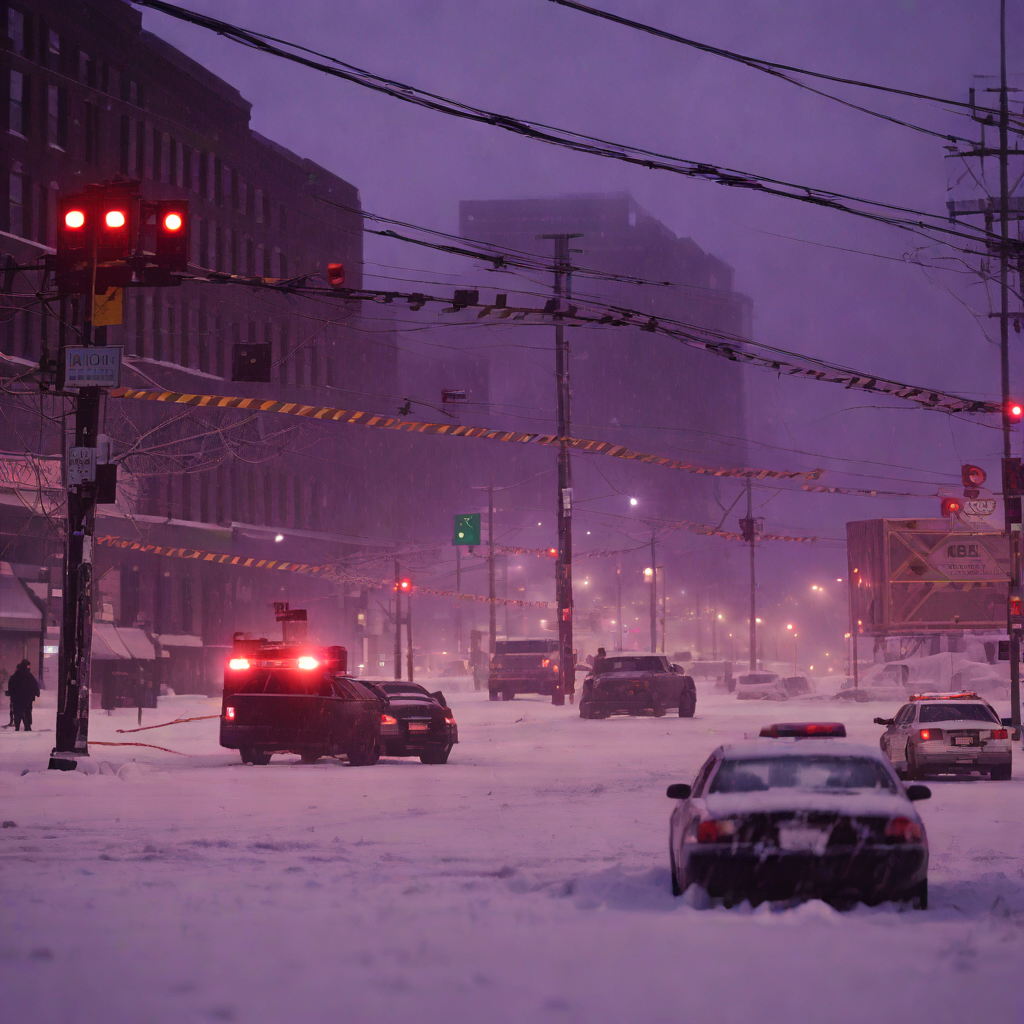
The wind chill on Hennepin Avenue had dropped to thirty degrees below zero when the first shot cracked through the howling wind, a sharp, mechanical retort that sounded less like gunfire and more like the snapping of the city’s frozen spine. It was 2:14 PM on January 27, 2026, but the sky over Minneapolis was a bruised purple, darkened by the "Arctic Bomb" blizzard that had buried the Midwest under four feet of snow in forty-eight hours. In the shadow of the snarled wreckage of the Northstar Commuter Rail—the twisted metal monument to what is now being called "Railgate"—Alex Pretti lay bleeding on the ice.
Pretti, a twenty-four-year-old volunteer with the localized mutual aid group "Winter Watch," hadn't come to the intersection of 1st and Washington to fight. While initial witness testimony circulated on social media suggested Pretti might have been armed, body-camera footage released by the Minneapolis Police Department earlier this morning appears to contradict those accounts, showing him carrying a crate of hand warmers and insulin, attempting to reach a makeshift shelter in the North Loop. His path, however, was blocked by paramilitary contractors hired by Trans-National Rail (TNR) to secure the derailment site. The collision that killed him was not a robbery or a gang dispute; it was a desperate skirmish over territory and resources in a city where the rule of law had frozen alongside the power grid.
"It didn't look like America anymore," recalls James Carter, a structural engineer trapped in his downtown apartment since the blizzard began. "It looked like a siege. You had these private security forces in tactical gear pointing rifles at shivering civilians who just wanted to cross the bridge to get to their families. Alex just stepped forward to talk to them. He had his hands up."
The death of Pretti is the visceral flashpoint of a "Compound Crisis" that policy analysts have been warning about since the start of President Trump’s second term. The deregulation of freight transport, championed by the administration as a means to "unshackle American logistics," directly contributed to the catastrophic failure of the switching mechanisms during the storm. A leaked preliminary report from the National Transportation Safety Board (NTSB) suggests that the heating elements in the track switches, mandated under previous safety protocols, had been decommissioned in late 2025 to cut operating costs. In a brief statement, a TNR spokesperson declined to validate the leaked document, emphasizing that "safety protocols met all federal guidelines in place at the time of operation" and urging the public to await the full investigation.
This infrastructure collapse did more than stop trains; it severed the social contract. In the vacuum left by the immobilized National Guard—whose deployment was delayed by the same blizzard—private interests filled the void. The contractors guarding the derailed TNR cargo were, according to allegations in a class-action lawsuit filed yesterday by the ACLU, instructed to prioritize "high-value assets" over public passage, effectively establishing a private border within an American city. Pretti’s death was the result of this privatization of order colliding with the desperation of public survival.
Railgate: When Infrastructure Betrays Ideology
The twisted steel on the outskirts of Minneapolis is not merely an industrial accident; it is the physical manifestation of a gamble taken by the Trump administration in early 2025—that deregulation would spur growth faster than entropy could degrade the system. They were wrong. The "Railgate" disaster, where a friction-bearing failure on a chemically laden freight line paralyzed the Upper Midwest's supply artery, did more than just freeze coal and grain shipments. It froze the civility of a city already on edge. When the power grids flickered and the heating fuel reserves dwindled due to the blockade, the social temperature spiked inversely to the sub-zero reality outside.
It is in this frozen pressure cooker that we must view the death of Alex Pretti. Police reports initially categorized the incident as a standard "dispute," a tragic but commonplace statistic. However, a deeper forensic analysis of the timeline suggests otherwise. Pretti wasn't killed in a vacuum; he was killed in a gridlock created by the derailment's exclusion zone, a direct downstream effect of the logistical paralysis. David Chen, a logistics coordinator who was trapped in the same traffic snarl for six hours, described the atmosphere as "feral." "People weren't just angry about the traffic," Chen notes. "They were terrified. The news said the chemicals were airborne, the gas stations were dry, and the government wasn't coming. When that driver pulled the gun on Pretti, it wasn't about a lane change. It was about survival."
Sociologist Dr. Elena Rostova argues that infrastructure is the "invisible constitution" of a nation. "When the bridges hold and the lights stay on, we agree to follow the rules," she explains. "When the physical world breaks, the social contract dissolves immediately." The Minneapolis incident proves that the distance between a functioning democracy and a violent struggle for resources is measured not in years, but in the thickness of a rail tie.
Two Truths, One Tragedy
In the forty-eight hours following the death of Alex Pretti, the American public did not mourn a single man; they mourned two distinct symbols, constructed in real-time by a media ecosystem that has lost the capacity for shared reality. On one frequency, Pretti was lionized as a "martyr of law and order," a vigilant citizen standing his ground against the looting mobs. On the other, he was eulogized as a "victim of systemic abandonment," a desperate worker crushed by corporate negligence.
The divergence began almost immediately. Conservative cable networks framed the shooting as the inevitable result of "progressive paralysis" in urban policing, citing the delay in National Guard deployment. The narrative was clear: Pretti was a stand-in for the "forgotten American," besieged by lawlessness. Conversely, the liberal media apparatus constructed a reality where the villain was the deregulation policies of the second Trump administration. In this version, Pretti was collateral damage in a war waged by private equity against public infrastructure.
Public Perception of 'Railgate' Primary Cause (Jan 2026)
For the average citizen, navigating this bifurcation is disorienting. Sarah Miller, a 44-year-old nurse practitioner in Columbus, Ohio, notes the confusion caused by conflicting push notifications. "One tells me Alex was a hero... The other tells me he was a victim of corporate greed. Neither tells me who he actually was." Her confusion correlates with a Pew Research Center study indicating trust in mass media has hit a historic low of 26%. The danger of these parallel realities is that they preclude a unified solution. If half the country believes Pretti died because of "soft-on-crime" policies, and the other half believes it was "corporate greed," the root cause—a rotting physical foundation—remains unaddressed.
The Vacuum of Authority
The silence from City Hall in the hours following the collapse was not merely a pause in communication; it was the acoustic signature of a governing apparatus in cardiac arrest. For Robert Vance, a 15-year veteran of the Minneapolis Emergency Communications Center, the breakdown was visible on his monitors long before it made the evening news. "Usually, there is a chain of command," Vance notes. "But when the rail line went down, we had federal agencies citing jurisdictional boundaries... The people on the ground were left to improvise."
This paralysis is the direct downstream effect of the "New Federalism" championed by the second Trump administration, which has devolved infrastructure maintenance to the states. A 2025 analysis by the Brookings Institution warned this would create "governance deserts." We are now standing in one. In this vacuum of official authority, fear became the interim governor. Citizens, feeling abandoned, retreated into defensive postures. Sociologist Dr. Elena Rosales describes this as "civic fragmentation," where neighbors view one another as potential threats. When Pretti crossed that intersection, he was navigating a failed state writ small.

The Exhausted Majority
While cameras focus on protesters, a different reality emerges in the darkened living rooms of the Twin Cities suburbs: the resignation of the "Exhausted Majority." According to the Q4 2025 Civic Health Index, 48% of Americans now report avoiding the news, a historic high. For Michael Johnson, a 34-year-old logistics coordinator in Saint Paul, "Railgate" isn't a political symbol but the reason his heating bill has spiked 40%.
"I see the alerts on my phone about Pretti... and I just swipe them away," Johnson says. "It’s not that I don’t care... It’s that I can’t do anything about it when I’m trying to figure out if we can afford to keep the thermostat at 68 degrees."
The Great Disengagement: Anxiety vs. Participation (2020-2026)
The data illustrates an "Apathy Trap": as anxiety climbs, participation falls. The killing of Alex Pretti has not galvanized the center; it has paralyzed it. When the median voter disengages, the public square is ceded to the fringes. If "Railgate" proves anything, it is that infrastructure is the physical manifestation of the state's promise. When the trains stop, the belief in a unified national project flickers.
The Algorithmic View: A Crisis of Signal
The digital echo of the gunshot that killed Alex Pretti reverberated through the nation's fiber-optic arteries before the physical investigation even began. In the chaotic hours following #Railgate, data traffic increased by 400%, but verifiable situational data plummeted. The feed of David Thorne, a 43-year-old logistics manager in St. Paul, illustrates this radicalization vector. Minutes after the derailment, his news stream prioritized high-arousal speculation—sabotage, terrorism—over reports of maintenance failure. By 9:00 AM, Thorne was consuming a curated reality tunnel framing the failure as an act of war.
Algorithmic Amplification of 'Sabotage' vs 'Maintenance' Narratives (First 24h of Railgate)
The tragedy of Alex Pretti is that he stepped into a physical space while inhabiting a digital reality where his neighbors had already been converted into enemies by engagement-seeking code. We are witnessing the result of a society that has outsourced its sense-making to algorithms that monetize fragmentation.
Re-stitching the American Fabric
The wreckage of the Minneapolis rail collapse tells a story older than the Arctic blast. It is the inevitable result of a "stress fracture" in the American social contract, where the neglect of physical foundations mirrors the erosion of civic trust. For decades, maintenance has been treated as an optional luxury. But physics cannot be spun. The "competence crisis" is the defining challenge of 2026.
(Structural Engineer) James Carter describes a paralysis born of polarization: "We treat every crack in the cement like a political argument. But concrete doesn't care if you're Red or Blue." This retreat from "boring competence" has left a vacuum filled by fear. However, a second path remains. In the immediate aftermath, it was local neighbors who pulled survivors from the snow, crossing political lines out of necessity.
The way forward is a return to the modest, essential virtues of stewardship—the "maintenance mindset." The memory of Alex Pretti demands more than a memorial; it demands a working country. If we cannot agree on the definition of liberty in 2026, we must at least agree on the necessity of a functioning sidewalk. Without that baseline of shared reality, there is no platform upon which to stand and argue about the rest.