The Fortified Forum: The Rising Cost of Political Access
Disruption in Minneapolis
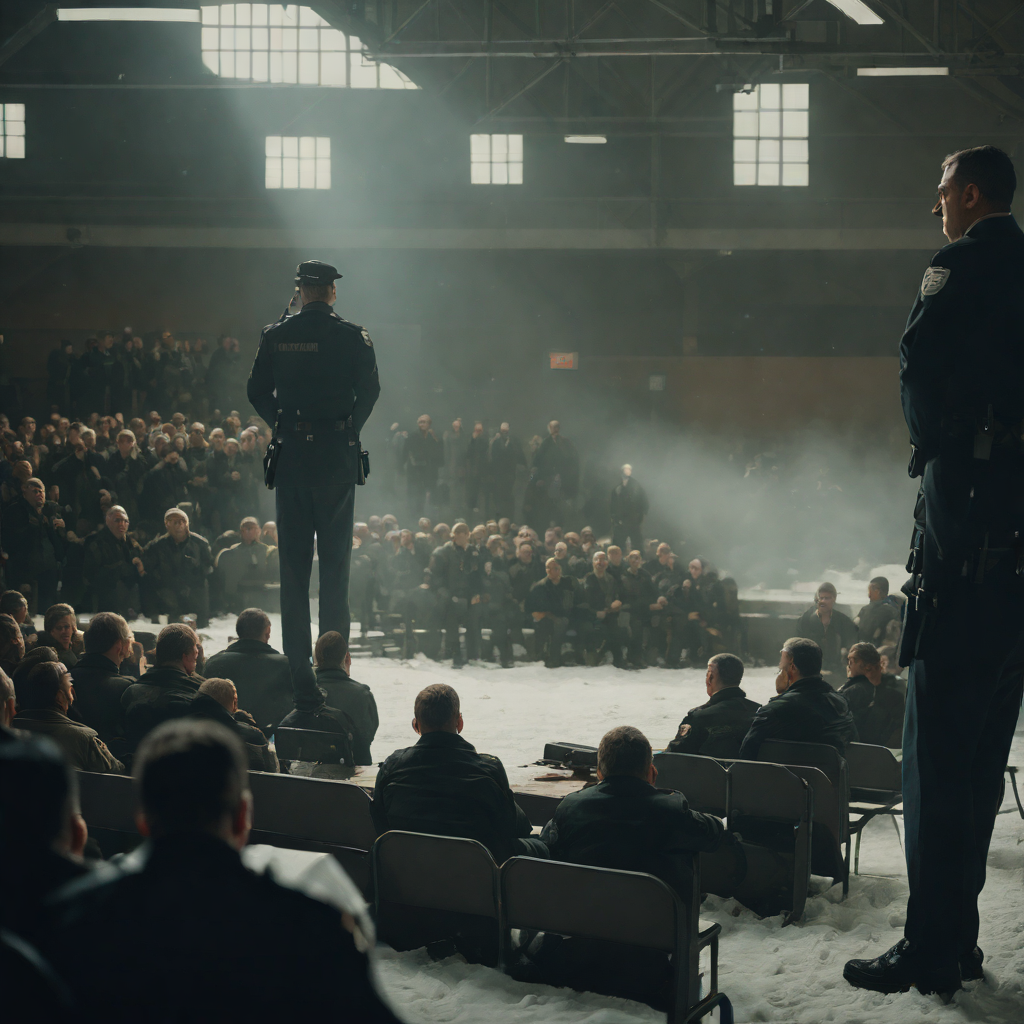
The gymnasium at the Brian Coyle Center in Minneapolis was intended to serve as a sanctuary of civic discourse. Outside, the January wind chill hovered near zero, a physical manifestation of the brutal "General Winter" currently gripping the Midwest. Inside, the atmosphere was heated but orderly—until the equilibrium shattered. The disruption did not arrive with the crack of a firearm, a scenario security teams have long drilled for, but with the silent arc of a container thrown from the middle rows. As the unknown liquid splashed across the dais near Representative Ilhan Omar, the mundane machinery of the town hall—the microphone feedback, the shuffling of papers, the murmured questions about housing subsidies—ceased instantly.
For attendees near the front, the seconds following the impact were defined not by the liquid itself, but by the crowd's reflexive terror. Witnesses described an immediate, collective assumption of the worst: that the liquid was acid or a biological agent. In the political climate of 2026, the interpretation of such disruptions has shifted; what might have once been perceived as a prank is now instinctively processed as an assassination attempt.
This psychological shift—the immediate leap to catastrophic thinking—marks a definitive casualty of the modern public square. While the liquid was later determined to be relatively harmless, the security protocol that followed was absolute: the Representative was rushed out, the room was cleared, and the dialogue ended.
The Statistics of Intimidation
The incident in Minneapolis is not an aberration; it is a data point in a grimly ascending trendline that has come to define the second term of the Trump presidency. Assessments based on United States Capitol Police (USCP) data indicate that threat cases against members of Congress were projected to approach historic highs in 2025, surpassing the volatile post-January 6th period of 2021 and establishing a new baseline for political risk.
The correlation, often described by analysts as "Policy Intensity," suggests that as the administration pushes aggressive deregulation and isolationist measures, the radicalization of political disagreement moves from online forums to physical spaces. The data reveals a disturbing stabilization of high-threat environments. While 2021 was viewed as a shock event, figures for 2024 and 2025 indicate that threat levels have plateaued at a "new normal" of near-constant danger.
Escalation: Threats Against Members of Congress (2021-2025)
Security analysts note that unlike previous spikes driven by singular events, the current volume of threats is sustained by a continuous cycle of polarizing executive orders and the retaliatory rhetoric that follows. The consequence of this sustained pressure is the rapid "bunkerization" of accessibility. Following the Minneapolis incident, security consultants for House leadership are reportedly advising a moratorium on open-floor town halls in favor of pre-screened, ticketed events—a move that fundamentally alters the constituent-representative relationship.
The Flashpoint: Policy Intensity
The debate over immigration enforcement has transitioned from a policy slogan into a visceral catalyst for confrontation. In the 2026 political landscape, where the Trump administration has doubled down on the revitalization of Immigration and Customs Enforcement (ICE) as a central pillar of national sovereignty, the friction between federal mandate and local resistance has reached a breaking point.
Observers navigating the complexities of the 2025 Border Security and Sovereignty Act have noted a tangible shift in temperature. Town halls, once venues for dry policy nuances, have become arenas where the air is thick with intensity—a feeling that every word spoken is a betrayal to one side or the other.
This surge in hostility is not localized to one side of the aisle. While the "Abolish ICE" slogan serves as a primary grievance for the right, the aggressive enforcement tactics of the current administration have sparked a parallel desperation on the left. In this environment, the public official becomes a lightning rod for the collective anxieties of a nation struggling to disagree without the threat of force.
The Accessibility Dilemma
The financial implications of this shift are creating a two-tiered system of representation. Security costs for rank-and-file members of the House have reportedly tripled since 2023. While leadership figures and high-profile incumbents can utilize robust campaign war chests to fund private protection details—often costing upwards of $5,000 per day—freshmen representatives and those in marginal districts are left vulnerable.
A 2025 analysis highlighted that campaign spending on personal security for non-leadership members has outpaced spending on polling for the first time in history. This creates a dangerous feedback loop. If safety requires wealth, the pool of viable candidates shrinks to those who can afford the overhead of their own survival.
Prospective candidates are increasingly quietly dissolving campaign committees before formally announcing, citing security costs as a primary deterrent. When the campaign budget must prioritize private security over voter outreach, the mathematics of running for office cease to make sense for the average citizen.
This represents the gentrification of political service, where the ability to interact with the public becomes a luxury good rather than a job requirement. The assault on Rep. Omar serves as a catalyst accelerating the closure of the American political mind, walling off representatives behind layers of security that, while necessary for their safety, effectively sever the empathetic governance that stems from direct constituent engagement.