Medical Balkanization: The Invisible Wall Separating American Families
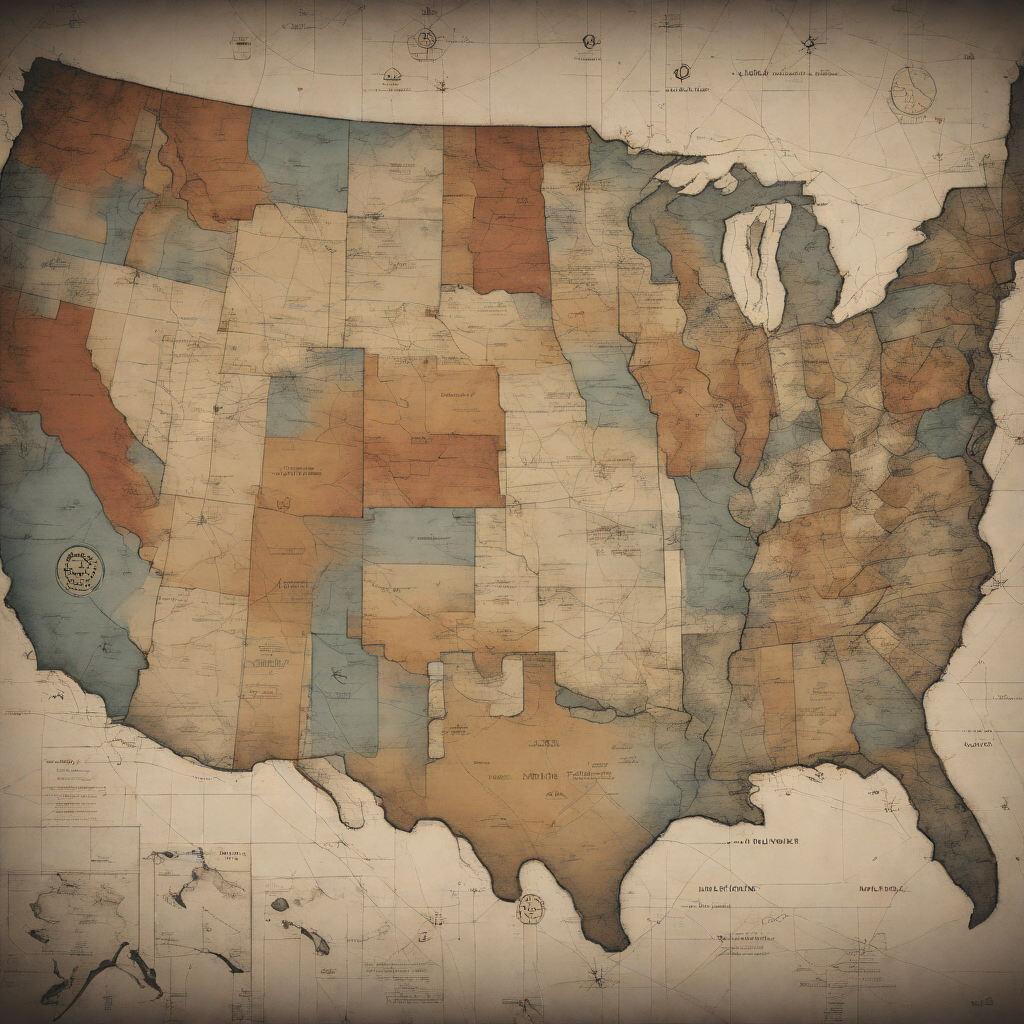
The New Mason-Dixon Line
For Sarah Miller, a systems architect, the promotion was supposed to be the culmination of a decade-long career climb. Relocating from Jacksonville, Florida, to the tech hubs of Boston offered a 40% salary increase and proximity to world-class universities for her two children. But the moving trucks had barely unloaded when the "invisible wall" of 2026 brought her family’s transition to a grinding halt.
The barrier wasn't physical, nor was it financial. It was bureaucratic, born from the widening chasm of American federalism. When Miller arrived at the local registrar’s office in Cambridge to enroll her six-year-old son, she was handed a rejection notice before she could even provide proof of residency. The issue? Florida’s "Health Data Sovereignty Act," signed into law in late 2025 to protect citizen privacy from federal overreach, had effectively scrubbed state registries of specific historical immunization data that Massachusetts’ "Public Health Shield" protocols strictly require.
"We followed the law in Florida," Miller explained, holding a folder of now-useless notarized affidavits. "And now we are being told that legally compliant documents in one state are effectively contraband in another. We aren't just moving across state lines; we are moving between different realities."
This is the new Mason-Dixon Line. It is not drawn on a map, but coded into the incompatible databases of state governments. The federal deregulation push of the second Trump administration, intended to "unshackle the American economy" by dismantling the Department of Health and Human Services' centralized oversight, has ironically birthed a rigid patchwork of medical fiefdoms. While the intention was to empower local governance, the result has been a logistical nightmare for the American labor force.

A Map Fractured by Mandates
The cartography of the United States in 2026 can no longer be understood simply through the binary of Red and Blue political districts. A more pragmatic, and economically bruising, map has emerged: the division between "Fortress States" and "Deregulated Zones." Following the administration's aggressive devolution of public health authority to the states last year—a move framed as the ultimate restoration of Tenth Amendment rights—a rigid patchwork of biological compliance standards has hardened into what effectively amounts to internal borders.
Nowhere is this friction more palpable than in the logistics of family migration. Emily Thorne, a school district administrator in Massachusetts, admits the system is failing families like the Millers but argues her hands are tied by state liability laws. "We cannot accept 'self-attested' records from states that have decoupled from the CDC's interoperability standards," Thorne notes. "If we admit a student without verifiable, state-backed history, we lose our own federal education grants. It’s a standoff where the children are the collateral damage."
For administrators, the result is a backlog of students who are physically present in the state but institutionally invisible. Thorne describes the situation as an "informational trade war," noting that her office now processes out-of-state applications with the same scrutiny formerly reserved for international visas.
Avg. Days to Process Out-of-State School Transfer (Jan 2024 vs Jan 2026)
The Corporate Compliance Quagmire
The friction is not isolated to the schoolyard; it extends deep into the corporate world. David Chen, a supply chain analyst attempting to transfer from Austin, Texas, to Seattle, Washington, faces a similar deadlock. Washington’s new environmental health mandates for 2026 require biological monitoring records for industrial workers that Texas explicitly banned employers from collecting last year.
Chen is currently living in a corporate short-term rental, unable to finalize his employment contract because his "compliance portfolio" is legally incomplete in the eyes of Washington state law. Furthermore, the "deregulated" health plans common in Texas, which strip away many mandates to lower premiums, often fail to meet the "comprehensive community coverage" minimums required by Washington state regulators.
A 2025 analysis by the Kaiser Family Foundation warned of this precise scenario: a "coverage cliff" where employees moving between regulatory regimes face sudden, five-figure spikes in out-of-pocket costs to bring their policies into compliance. For Chen, the cost of bridging this gap erased the salary increase associated with his promotion, turning a career advancement into a net financial loss. "It wasn't a move across the country," Chen noted. "It felt like moving to a different country with a worse exchange rate."
Avg. Annual Cost of Healthcare Compliance Adjustment for Interstate Moves (2022-2026)
The Macroeconomic Toll
Economists are beginning to quantify the cost of this "Medical Balkanization." Labor mobility, traditionally a hallmark of the dynamic US economy, has dipped to its lowest point in two decades. When professionals cannot move because their health identities cannot migrate with them, the "free market" becomes theoretical rather than functional.
Preliminary figures from the Bureau of Labor Statistics suggest a cooling in interstate migration rates for the 2025 fiscal year, specifically between states with high regulatory disparities. We are witnessing the formation of two distinct labor pools, separated not by tariffs, but by the incompatibility of their biological and administrative citizenship. As states diverge in their regulatory frameworks—Red states prioritizing privacy and deregulation, Blue states prioritizing comprehensive public health tracking—the actual movement of people slows.
US Interstate Migration Rate vs. State Regulatory Divergence Index (2020-2026)
Pandora’s Box of Liability
The deregulation of 2026 was marketed as a liberation of the American healthcare consumer, yet it has opened a Pandora’s box of liability that is actively paralyzing interstate mobility. The conflict is no longer just about policy; it has moved to the courtroom, pitting the fundamental right to travel against the newly emboldened sovereignty of state health departments.
School administrators and HR directors are not acting out of malice, but out of existential fear of litigation. Linda Weber, a veteran superintendent in the Greater Boston area, argues that the collapse of federal preemption has stripped her district of its safety net. "Before 2026, if we followed federal guidelines, we were generally shielded," Weber says. "Now, if we accept an out-of-state medical plan that clashes with our Commonwealth’s specific statutes—even on a technicality—and something goes wrong, we are entirely exposed."
Legal scholars warn that these skirmishes are merely the preamble to a much larger constitutional crisis. When a state’s health sovereignty effectively acts as a tariff on labor mobility, it arguably violates the Commerce Clause. Yet, with the current Supreme Court showing a marked preference for state autonomy, the outcome of the inevitable lawsuits is far from certain. We are left with a fractured republic where the "United" States feels increasingly like a collection of wary, litigious neighbors peering over high fences.

The Algorithmic Prognosis
In the new cartography of the United States, state lines have calcified into what epidemiologists are quietly calling "hard borders of biological probability." While the Trump administration’s 2025 "Health Sovereignty Executive Order" successfully dismantled federal oversight in favor of state-level autonomy, it has inadvertently birthed a fragmented data landscape where predictive algorithms—the very tools intended to modernize public health—are failing to cross state lines.
The core of this dysfunction lies in "regulatory porosity." By allowing states to opt out of federal data-sharing exchanges, the administration created two distinct classes of jurisdiction: "Data-Sovereign" states, which prioritize privacy, and "Data-Integrated" states, which maintain high-surveillance public health models. For algorithms trained to detect disease vectors or calculate insurance risk, a citizen moving from a Sovereign state to an Integrated one appears less like a relocating worker and more like a high-risk variable with missing history.
Proponents of the administration's policy argue that this friction is a temporary growing pain, asserting that the private sector will eventually build bridges to handle data portability. However, the current reality suggests the opposite: a hardening of digital borders where your zip code determines not just your taxes, but the validity of your biological identity. As long as algorithms prioritize data continuity, the United States remains divided not just by politics, but by the compatibility of its databases.