The Vinegar Incident: Minneapolis and the Crisis of Open Democracy

A Town Hall Turning Point
The incident at the Minneapolis town hall unfolded with the banality of a routine constituency meeting before descending into chaos. As Representative Ilhan Omar addressed a packed room regarding local infrastructure concerns, a liquid was hurled from the crowd, striking the Congresswoman and splashing nearby attendees. In the hyper-vigilant atmosphere of January 2026, where political violence has transitioned from abstract threat to recurring headline, the immediate reaction was driven by primal fear. Security details, trained to anticipate everything from ballistics to biological agents, immediately swarmed the stage, while the crowd recoiled, fearing an unknown chemical agent.
For several agonizing minutes, the air in the community center was thick with a sharp, acidic scent, triggering a lockdown protocol reserved for hazardous material attacks. However, subsequent analysis by law enforcement revealed a stark reality: the substance was not a sophisticated binary weapon or industrial caustic, but a crude mixture of water and apple cider vinegar. Unlike the acid attacks seen in parts of Europe, this concoction was chemically benign. Yet, the choice of a pantry staple with a distinct, sharp odor was calculated. It successfully mimicked the sensory profile of a chemical assault, achieving the attacker’s goal of psychological disruption without carrying the legal weight of a lethal weapon.
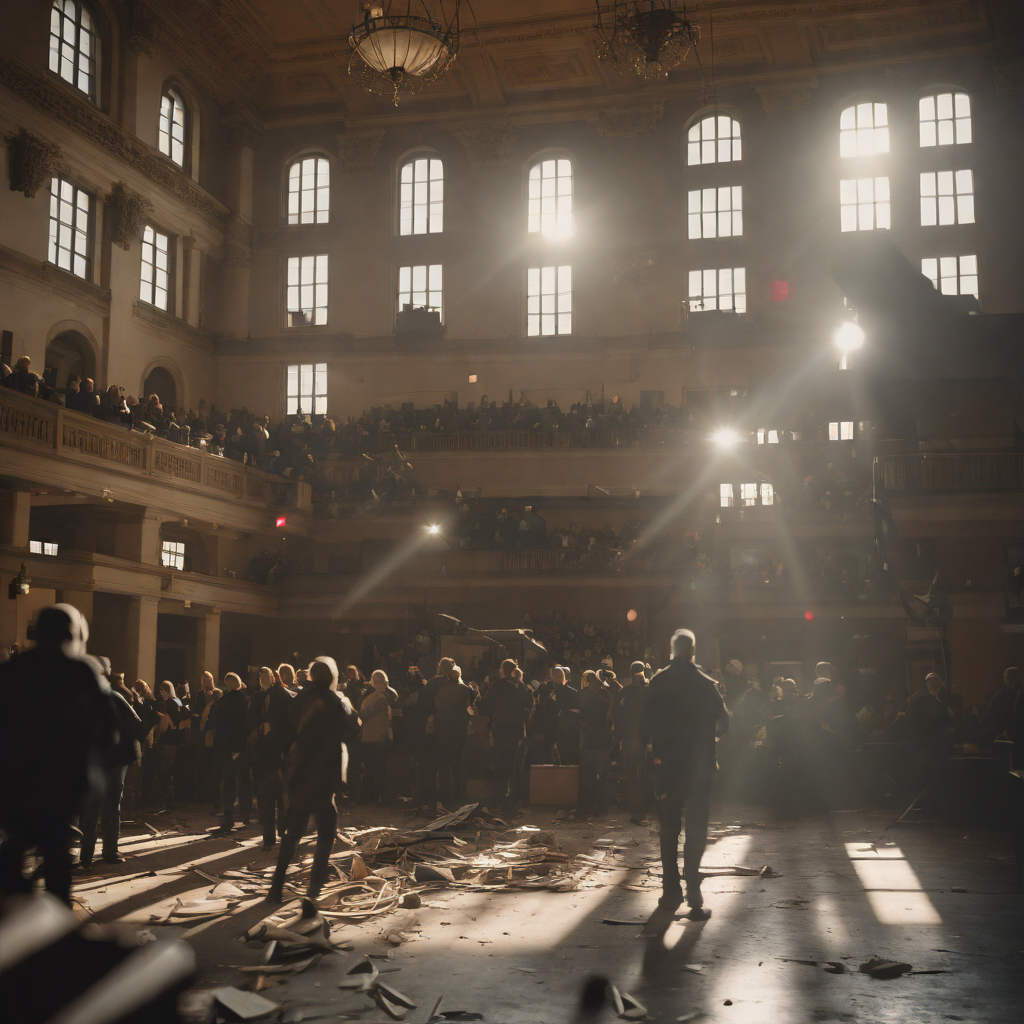
"David Chen," a Minneapolis resident who had brought his teenage daughter to witness civic engagement firsthand, described the paralysis that gripped the room. "The smell hit us before we understood what was happening," Chen recalled. "It was sharp and acidic. In that split second, you aren't thinking about salad dressing; you're thinking about skin grafts and blinding. It turned a town hall into a crime scene in a heartbeat."
The Weaponization of the Benign
This tactical pivot represents a disturbing evolution in political intimidation, which analysts are calling the "weaponization of the benign." By utilizing non-lethal, accessible household items, perpetrators exploit the "gray zone" of the legal system. The physical damage is negligible—a ruined outfit, a stinging eye—but the psychological breach is total.
Anthony Kazmierchak, now facing assault charges, allegedly utilized this mixture to breach the psychological safety of a public servant without triggering the immediate, lethal response that a firearm would invoke. The volatility of the situation lies in the split-second of uncertainty. For the victim and her security detail, the liquid splashing across a jacket could be hydrochloric acid or a biological agent. This ambiguity paralyzes standard engagement protocols; a security officer cannot easily justify lethal force against a suspect holding a plastic bottle, yet the potential threat remains existential until the substance is identified.
"We are seeing a shift from assassination attempts to humiliation rituals," notes "James Carter," a threat assessment consultant based in Washington, D.C. "The goal isn't always to kill; it's to make the target afraid to walk in public, and to force the state to overreact. By using a pantry item, the attacker effectively mocks the security apparatus."
Minneapolis at the Breaking Point
The assault did not happen in a vacuum; it occurred in a city already pushed to its civic limits. January 2026 will likely be remembered in Minneapolis history as the month the infrastructure cracked alongside the social contract. With the "Minneapolis Freeze" shattering water mains and leaving thousands without reliable heating, the Twin Cities have become a landscape of tangible frustration. It is within this theater of urban breakdown—where citizens are already navigating ice-choked streets and failing utilities—that the attack on a sitting Congresswoman resonates with particular grimness.

"Marcus Thorne," a local transit worker who witnessed the chaotic aftermath near the event site, highlighted the psychological asymmetry of the attack. "You see someone throw liquid, and the smell hits you, and for ten minutes, nobody knows if it's going to burn or just stink," Thorne noted. "The fear is real, even if the weapon is from a kitchen cabinet."
This "pantry terrorism" exploits the fragility of open democratic spaces. It forces a difficult conversation about security in the Trump 2.0 era: How do you police the possession of salad dressing ingredients without turning town halls into TSA checkpoints? The incident suggests a calculated evolution in political intimidation, where the goal is to degrade the target and disrupt public discourse without guaranteeing a felony prison sentence.
The Bunker Democracy Dilemma
The chilling effect of this "soft" violence is already reshaping civic participation at the granular level. "Michael Henderson," a precinct chair in Minneapolis who has managed local polling stations for over a decade, notes a drastic shift in the willingness of citizens to engage in public service.
"It used to be about long hours and bad coffee," Henderson explains, noting that volunteer applications in his district have dropped by 40% since 2024. "Now, people are asking if we have budget for ballistic glass or if they need to scrub their social media presence before signing up. When a vinegar dousing is treated as legitimate political discourse, the next step isn't debate; it's escalation."
Henderson’s experience reflects a national trend. A 2025 report by the Brennan Center for Justice highlighted that threats against local officials have migrated from online anonymity to physical proximity, forcing a quiet exodus of institutional knowledge from the American electoral system.
Reported Threats Against US Congress Members (2021-2025)
We are witnessing the acceleration of the "Bunker Democracy," a phenomenon where the physical accessibility of representatives—once a hallmark of the American experiment—is being traded for their physical survival. Security analysts argue that this distancing is a necessary adaptation to a hyper-polarized environment. Under the current Trump administration, the rhetoric regarding "enemies within" has dovetailed with a genuine spike in threat assessments against members of Congress from both parties. The logic of the fortress state is seductive in its efficiency: by isolating the leader, you ensure the continuity of government. However, this isolation creates a feedback loop of distrust.
The Algorithmic Eye and the Future of Dissent
The attack was not a spontaneous eruption of violence, but the inevitable spilling over of a digital cup that had been filling for months. The digital infrastructure that encouraged the act is sophisticated, pervasive, and currently operating without significant guardrails.
The choice of weapon—common apple cider vinegar diluted with water—presents a paradox that security algorithms struggle to parse. Unlike the ammonia or industrial-grade chemicals initially feared in early reports, the actual mixture is benign in isolation. It triggers no watchlists; it requires no background checks. As "Dr. Aris Thorne," a former threat analyst for a major social media platform, explains, "We have robust filters for biological agents, gun parts, and explicit calls for lethal violence. We do not, and cannot, effectively flag the purchase or discussion of grocery items, even when the context—the 'doping' of a political figure—screams intimidation."
This incident forces a binary choice upon the American electorate and its leadership in 2026: retreat into a "Fortress Democracy" or undertake the arduous work of de-escalation. The vinegar mixture may have been easily washed away, but the stain it leaves on the democratic process is indelible. We are witnessing the cost of a society that has lost the ability to distinguish between political opposition and existential enmity, leaving the public square dangerously open to those who view intimidation as a valid campaign tactic.