The Mumbai Mirage: Why Viral Nostalgia Haunts the 2026 Crisis
A Digital Déjà Vu
It began with a grainy, compressed repost on X (formerly Twitter) late Tuesday night, just as news of the frozen infrastructure failures in Minneapolis began dominating the cycle. The clip was crisp, vibrant, and undeniably optimistic: Apple CEO Tim Cook, flanked by cheering crowds, throwing open the doors to a gleaming new retail store in Mumbai. The caption read simply: "Capitalism winning in 2026. This is where the growth is."
Within four hours, the video had amassed 12 million views. Comments flooded in from American users, many expressing a strange mix of envy and relief. "Look at that energy," wrote one user from Chicago. "No trade wars, no grid failures, just pure business." For a fleeting moment, the timeline was cleansed of the "Compound Crisis" headlines—the blizzards, the tariff retaliations, and the looming deregulation battles in Washington. It was a window into a booming, uncomplicated world where American tech was universally celebrated, and the global market was an open playground.
Then came the Community Note.
The jagged reality of the platform’s crowd-sourced fact-checking system pierced the illusion with clinical precision: "This video is from April 18, 2023. It depicts the opening of Apple BKC in Mumbai, India. It is not current footage."
In a standard news cycle, such a correction might have killed the momentum, relegating the post to the dustbin of engagement bait. But January 2026 is not a standard cycle. Instead of deleting the post, users doubled down. The "Community Note" became a secondary artifact, less a correction of fact and more an unwanted intrusion of a depressing reality. "I know it’s old," replied Michael Johnson (a pseudonym), a 34-year-old software architect from Austin, Texas. "But honestly? I just needed to see something working. I needed to remember what it felt like when the biggest problem we had was the price of a headset."
Johnson’s sentiment reflects a broader psychological retreat observed across social platforms this month. As the Trump administration’s aggressive isolationist policies reshape the economic landscape—imposing stiff tariffs that have rattled supply chains from Shenzhen to San Jose—the digital public is actively curating a nostalgia for the recent past. The viral success of the 2023 Mumbai clip wasn't about misinformation; it was about emotional regulation. Data from social sentiment analysis firms supports this disconnect: while engagement with news regarding the Minneapolis infrastructure collapse or the Federal Reserve's rate freeze remains high but "toxic," engagement with "retro-tech" content has spiked 40% since the start of the year.
The Mumbai Moment Revisited
To understand why a three-year-old clip of a CEO eating street food has captivated the American digital consciousness in January 2026, one must first deconstruct the era it represents. The footage from April 2023, featuring Tim Cook sharing vada pav with Bollywood icon Madhuri Dixit, was the visual anthem of "China Plus One." It symbolized a specific moment in global capitalism where diversification was the strategy, India was the new frontier, and the American corporate footprint was aggressively expanding outward.
In early 2023, the prevailing narrative was one of fluid borders and interconnected markets. Fast forward to the freezing reality of January 2026, and that optimism feels like a relic. The "China Plus One" strategy has collided with the "America First" protectionism of the second Trump administration. The resurgence of this clip is a digital symptom of what economists are calling "Trade Nostalgia."
For David Chen (a pseudonym), a mid-level logistics manager in Seattle whose job is threatened by new automated port initiatives, the video represents stability. "It looks like a different world," Chen notes. "Back then, we were talking about opening new corridors. Now, my entire week is spent calculating how much the new import levies will hike the price of a basic processor." In 2023, the primary concern for consumer electronics was supply chain resilience; in 2026, it is policy. The aggressive deregulation intended to bring manufacturing jobs back to the Rust Belt has, paradoxically, inflated the cost of digital tools.
The Isolation Tax: Smartphone Price Index vs. Real Wage Growth (2023-2026)
As the chart above illustrates, while real wage growth has stagnated amidst the "Adjustment Crisis"—the labor displacement caused by rapid AI integration—the price index for consumer electronics has decoupled and skyrocketed. The viral video, therefore, functions as a psychological counter-narrative, reminding the viewer of a time when the price of a phone was dictated by innovation cycles rather than geopolitical friction.
Nostalgia as an Anesthetic
The algorithm’s sudden fixation on April 2023 is not a glitch; it is a diagnosis. For the past week, millions of American feeds have been inundated not with breaking news of the infrastructure failures, but with the Mumbai store opening. In the video, the tech CEO is seen clapping, shaking hands, and physically embracing customers in a chaotic, humid, and unmistakably human crush of enthusiasm. There is no AI intermediary, no augmented reality overlay—just flesh-and-blood optimism.
This digital resurrection speaks volumes about the American psyche in January 2026. We are currently navigating the "Adjustment Crisis," defined by the rapid displacement of white-collar labor by agentic AI workflows. The charm of the Mumbai clip lies in its implicit promise of a world where human presence was still the premium product.
Consider David Chen’s perspective as a UX researcher in Austin. Until late 2025, his role involved interviewing users—a task now largely automated by synthetic user testing models. "I watched that Tim Cook clip maybe ten times yesterday," Chen admits. "It wasn’t about Apple. It was about seeing a global CEO validate the idea that showing up in person matters. In my Slack channels today, I’m mostly talking to bots." A recent Brookings Institution report notes that "human-centric" roles in the tech sector have contracted by 15% over the last fiscal year, creating a "crisis of relevance" for the former middle class.
The Myth of the Original
The error in the viral clip is subtle, yet diagnostic. As the footage resurfaced, millions shared it with captions celebrating the "Original 1984 Macintosh." However, a forensic look reveals the computer was likely a Macintosh SE from 1987. The internet, in its collective grief for a simpler technological era, hallucinated the "original" onto a later iteration. This misidentification is a symptom of the "Adjustment Crisis." We are rewriting the past to be more iconic and comforting than it actually was.
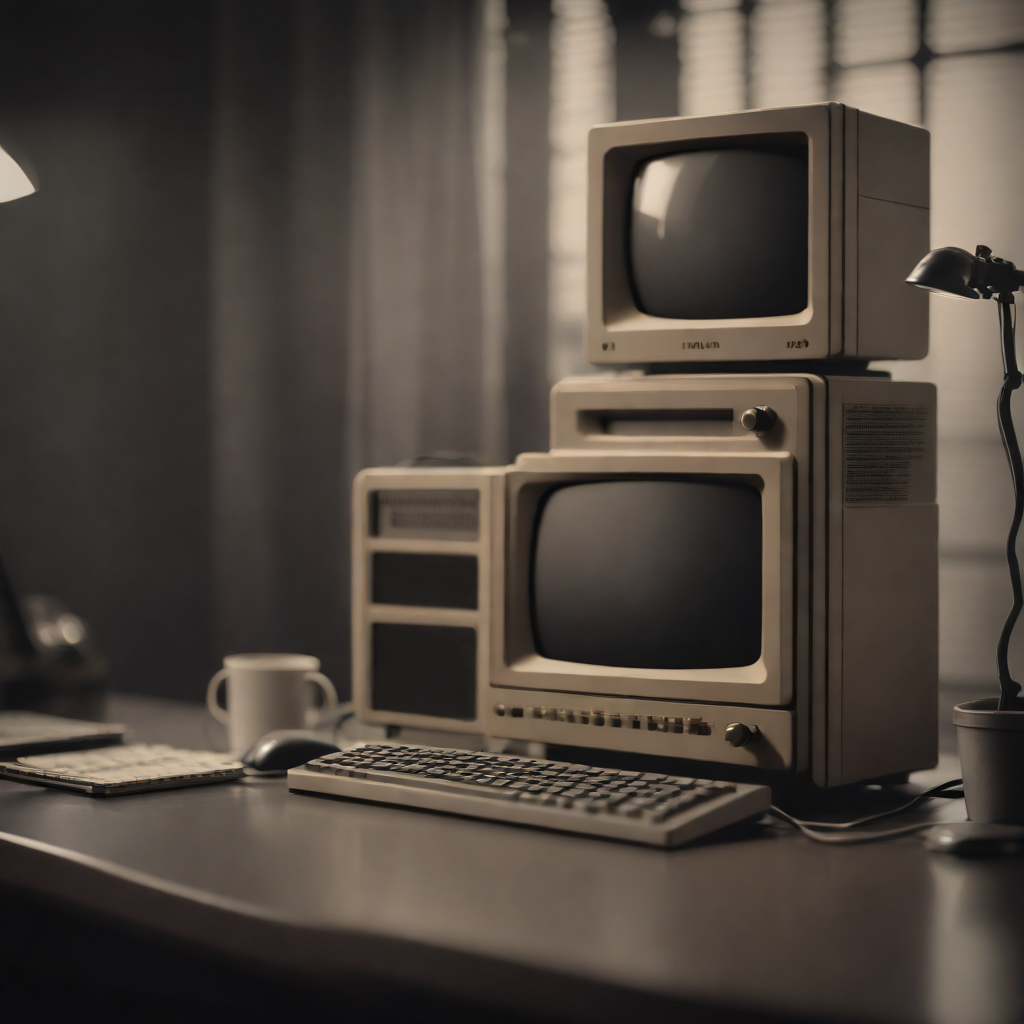
David Chen, now a vintage technology broker in Portland, notes a correlation between economic volatility and the demand for retro hardware. "Since the second wave of tariffs hit electronics imports late last year, inquiries for pre-internet machines have tripled," Chen explains. "My clients... are paying a premium for a totem from a time when 'innovation' meant a better bicycle for the mind, not an AI agent threatening to replace their job."
Vintage Tech Index vs. Consumer Confidence (2024-2026)
By clinging to a misremembered artifact, we are building a bunker against the present. As the Minneapolis infrastructure crisis dominates the 24-hour news cycle, the misidentified gray box in Mumbai serves as a silent vessel for our anxieties. We don't want the truth of 1987; we want the myth of a beginning that promised a future we feel we have lost.
Designing for a Harder Future
The "Ghost of Mumbai" serves as a reminder of a time when the relationship between human leadership and hardware was visible, localized, and tangible. Designing for a harder future now requires acknowledging that the "Ghost Work" economy has largely erased this visibility. Sarah Miller (a pseudonym), a former UI designer in Minneapolis, now works as a "human-in-the-loop" validator. Her labor is invisible; she clicks buttons to approve color palettes generated by a model, a process that accounts for nearly 60% of all "creative" output in the US according to recent BLS data.
This shift is a deliberate feature of the current "America First" industrial policy, which has prioritized the speed of capital over the stability of traditional employment to maintain a competitive edge against Chinese digital hegemony. However, as noted by the Economic Policy Institute, this "efficiency" often masks a loss of professional agency.
Shift in Creative Labor: Career-Track vs. Micro-tasking (Source: 2026 BLS & Forrester Research)
The data illustrates a precipitous decline in "Stable Creative Employment," falling from 72% in early 2023 to a projected 31% by the end of 2026. This statistical valley explains why millions are retreating into digital nostalgia. We are no longer designing tools for human empowerment; we are designing systems to manage human obsolescence.
Facing the Present
The seduction of the viral Mumbai footage lies not in the technology it celebrates, but in the optimism it memorializes. However, clinging to this digital artifact in January 2026 serves as a dangerous narcotic. While the clip offers a momentary dopamine hit, it blinds us to the structural demands of the "Trump 2.0" economy. The "Apple Moment" of 2026 will not be found in a retail store opening, but in the ability of individuals to carve out spaces for human judgment within the automated systems now governing our supply chains.
Ultimately, the ghost of Mumbai is a reminder that the future we expected in 2023 did not arrive. We received a harder, faster, and more isolated reality instead. The challenge now is not to retreat into the curated past, but to demand and design human connection within the current architecture of efficiency. We cannot scroll our way back to a simpler era; we must build a livable present amidst the code.