The 'V0' Verdict: South Korea's Judicial Crisis and the Shadow of Power

The 'V0' Paradox: When the First Lady Outranks the President
The silence inside the Seoul Central District Court earlier this week was shattered not by the gavel, but by the gasp of collective disbelief that followed. For months, the prosecution had built a methodical case against First Lady Kim Keon-hee, culminating in a stern demand for a 15-year prison sentence. This figure was not arbitrary; it was calculated to reflect the severity of alleged stock manipulation and to signal that the rule of law in South Korea remained blind to status. However, the court’s final decision—a ruling that evaporated the prosecution's 15-year benchmark into an outcome widely perceived as a slap on the wrist—has done more than resolve a legal battle. It has weaponized the term "V0" (VIP Zero) from an internet murmur into a rallying cry for the opposition, cementing the public perception that the First Lady effectively outranks the President himself.
For American observers, the implications extend far beyond the tabloids of Seoul. South Korea is not merely a trading partner; it is a linchpin of the US Indo-Pacific strategy, hosting nearly 30,000 American troops. Stability in the Blue House is a prerequisite for security in the region. Yet, legal analysts warn that the chasm between the 15-year demand and the actual verdict suggests a judicial system buckling under executive pressure. "It sends a chilling signal to the market," argues David Chen, a senior risk analyst at a New York-based investment firm specializing in Asian markets. "When a prosecutor asks for 15 years and the system delivers impunity, foreign investors have to ask: Is the regulatory environment actually neutral, or is it feudal?"
This "V0" phenomenon mirrors anxieties currently simmering in Washington under the Trump administration, where debates over executive immunity and judicial independence have dominated the headlines in 2026. But in Seoul, the crisis is visceral. The "V0" label implies an inversion of constitutional order—that the unelected spouse holds the true sovereign power, rendering the elected President (VIP 1) a secondary figure. This perception is dangerous because it strips the administration of its democratic mandate. If the public believes that the judiciary cannot enforce a 15-year penalty—or indeed any meaningful penalty—against the "VIP Zero," the social contract that underpins South Korea's dynamic but fragile democracy begins to fray. The verdict has thus transformed a criminal trial into a stress test for the nation's institutions, leaving the US State Department to watch closely as a key ally navigates a crisis of legitimacy that no amount of diplomatic protocol can obscure.
A Math Problem of Justice: 15 Years vs. 20 Months
In the calculus of criminal justice, the variables typically follow a predictable logic: the severity of the crime plus the strength of evidence equals the severity of the sentence. Yet, in the Seoul Central District Court this week, that equation collapsed spectacularly. The prosecution, representing the state, had calculated a debt to society worth 15 years of imprisonment for First Lady Kim Keon-hee. The judiciary, however, returned a figure that has baffled legal scholars and ignited the streets: 20 months, suspended.
To understand the depth of the public’s fury, one must first understand the input. The prosecution’s 15-year sentencing demand was not a figure drawn from thin air; it was a cumulative calculation based on two distinct but heavy allegations: the alleged reaping of illicit profits from the Deutsch Motors stock manipulation scheme and the acceptance of a luxury Dior bag as an improper gratuity. Prosecutors argued that the evidence pointed to a pattern of systemic corruption, asserting that the First Lady was not merely a passive beneficiary but an active participant. This 15-year figure was intended to be a firewall, a statement that in a mature democracy, no individual sits above the penal code.
The court’s verdict, however, effectively dismantled this firewall brick by brick. By acquitting Kim on the stock manipulation charges—citing insufficient proof that she was cognizant of the specific manipulative trades despite her accounts being utilized—the bench hollowed out the bulk of the prosecution's leverage. What remained was the graft charge related to the luxury handbag. Here, the court acknowledged the violation but applied maximum leniency, resulting in a prison term of one year and eight months (20 months), suspended for three years. In practice, this means zero days in a cell.
The Gap: Prosecution Demand vs. Final Verdict (Years)
This arithmetic—15 years reduced to a suspended sentence—has breathed dangerous life into the "V0" (VIP Zero) theory dominating Seoul’s political underground. The moniker implies that the First Lady operates as "Zero," a rank superior to the President (V1), effectively placing her outside the jurisdiction of standard law. For the opposition Democratic Party, the verdict is validation of their claim that the prosecutor's office has been defanged by the very administration it is meant to check.
For American observers, particularly those in Washington and on Wall Street, this judicial dissonance rings an alarm bell that has little to do with partisan politics and everything to do with market stability. South Korea is a linchpin in the U.S. semiconductor supply chain and a critical security partner in the Indo-Pacific. A judicial system that appears malleable for the political elite introduces a layer of sovereign risk that cannot be hedged. If the "Korea Discount"—the persistent undervaluation of South Korean stocks—was previously blamed on North Korean belligerence, it may now find a new driver in the unpredictability of the rule of law in Seoul.
Gwollryeok-hyeong Biri: Corruption with a Safety Net
In South Korea, there is a specific legal phrase that carries a weight heavier than mere malfeasance: Gwollryeok-hyeong Biri, or "power-backed corruption." To the American observer, accustomed to the mechanics of RICO statutes or corporate fraud, this term implies something more systemic—corruption not just committed by the powerful, but actively insulated by the machinery of the state. The recent judicial proceedings against First Lady Kim Keon-hee have elevated this concept from a domestic grievance to an international geopolitical risk factor, centering on a verdict that many observers argue has shattered the facade of equality before the law.
The inflection point of this crisis was the prosecution's sentencing demand. In a move that initially stunned the Seoul establishment and signaled a potential return to rigorous judicial independence, prosecutors formally requested a 15-year prison term. This aggressive posture appeared to be a direct rebuttal to accusations of leniency, ostensibly drawing a line in the sand regarding the First Lady's alleged involvement in stock manipulation and influence peddling. For international investors watching from New York and London, the 15-year figure was interpreted as a sign of institutional resilience—a signal that the South Korean judiciary remained robust enough to check executive overreach.
However, the subsequent delivery of the final verdict—which fell drastically short of this 15-year benchmark—has precipitated what opposition leaders are calling a "V0" crisis. The term "V0," or "VIP Zero," implies a hierarchy where the First Lady sits above the President (VIP 1), effectively operating outside the constitution's gravitational pull. By disregarding the prosecution's substantial 15-year recommendation in favor of a sentence widely perceived as a "safety net," the court has inadvertently validated the cynical view that the rule of law in Seoul is tiered based on proximity to the Yongsan presidential office.
For James Carter, a senior analyst at an investment firm specializing in Asian emerging markets, the discrepancy is not just a political drama but a tangible economic indicator. "When you see a prosecutor ask for 15 years based on evidentiary review, and the judiciary pivots to near-total leniency without a transparent bridge between those two numbers, the 'Korea Discount' stops being about dividends and starts being about governance risk," he notes. The concern for US stakeholders is that if Gwollryeok-hyeong Biri effectively immunizes the executive core from market regulations, the predictability essential for foreign direct investment evaporates. In the era of Trump 2.0, where trade alliances are transactional and scrutinized for stability, South Korea's internal judicial fracturing presents a vulnerability that goes beyond domestic politics, threatening the very reliability of a key strategic partner in the Indo-Pacific.

Echoes of 2016: The Ghost of Impeachments Past
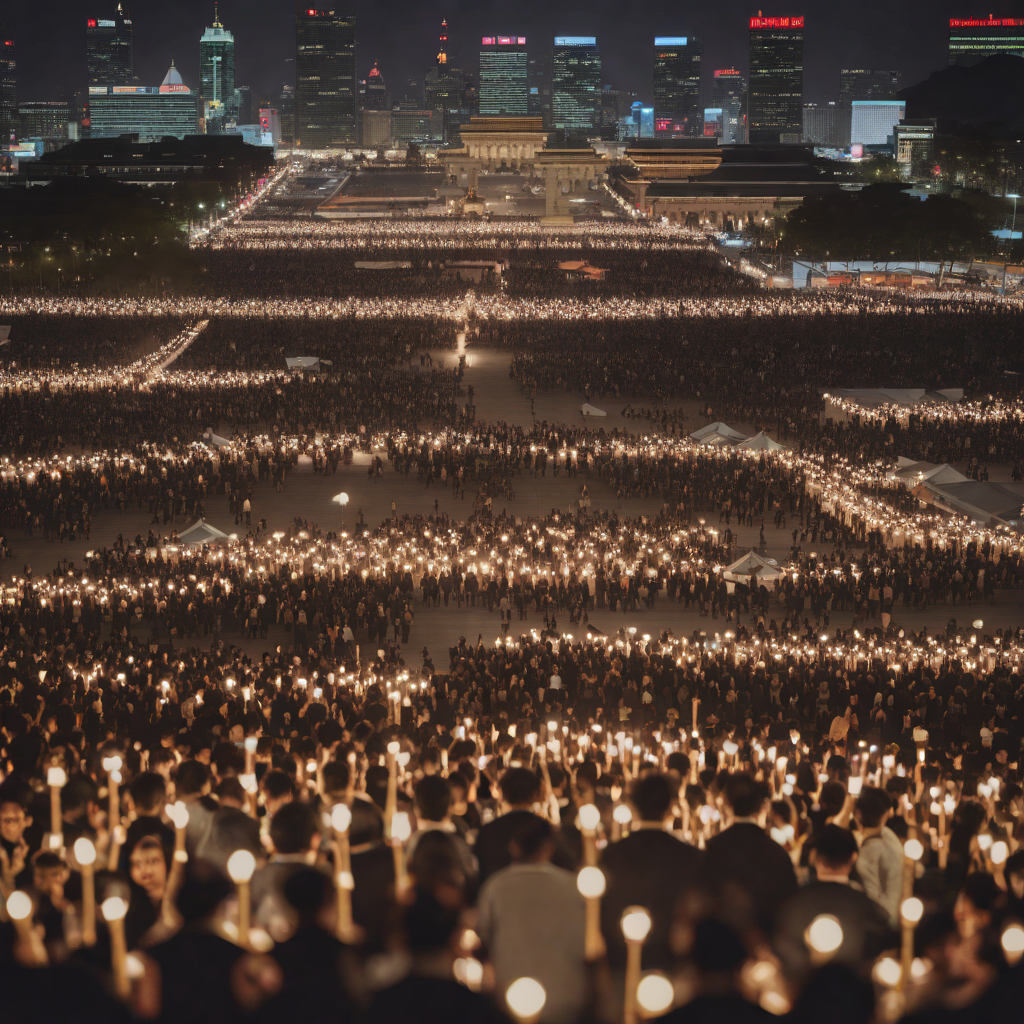
For observers in Washington, the scenes unfolding in Gwanghwamun Square carry a haunting familiarity. Ten years after the candlelight vigils that ousted President Park Geun-hye, the humid night air of Seoul is once again thick with the chants of a populace convinced that their democracy has been hijacked by an unelected power. But unlike the "Rasputin-like" influence of Choi Soon-sil in 2016, the figure at the center of today's storm resides not in the shadows, but in the presidential residence itself.
The catalyst for this renewed civic fury lies in a single, jarring number: 15 years. That was the prison term prosecutors demanded for First Lady Kim Keon-hee, a figure that signaled the state's intent to treat the "Dior Bag" scandal and alleged stock manipulation as grave crimes against the economic order. For weeks, legal analysts had suggested that a double-digit demand would force the judiciary's hand, creating a firewall between the President's administration and the rule of law. Instead, the final verdict—delivered with a leniency that stunned even veteran court watchers—has shattered that firewall. The disparity between the 15-year demand and the court's ultimate decision has done more than just clear a legal docket; it has validated the "V0" (VIP Zero) theory, the popular belief that the First Lady sits above the President (V1) in the hierarchy of power.
"It feels like we are watching a rerun of a tragedy we promised never to repeat," says Park Ji-hoon, a 42-year-old software engineer who joined the protests near City Hall. "In 2016, we learned that unverified power corrupts. Today, the court told us that some power is simply immune to verification."
The Fractured Social Contract
In the streets of Seoul, the cold winter air of January 2026 is thick with a sentiment that American observers might recognize from the Occupy Wall Street era, though distinct in its cultural manifestation: a profound betrayal of the "fairness" narrative. For decades, South Korea’s rapid industrialization was underwritten by a tacit social contract: hard work yields upward mobility, and the law, while occasionally bending for the chaebols, would ultimately hold the highest public offices accountable. The recent verdict regarding First Lady Kim Keon-hee has shattered this fragile truce.
The crux of the outrage lies not merely in the alleged crimes—stock manipulation and the acceptance of luxury gifts—but in the mathematical impossibility of the judicial outcome compared to the prosecution's assessment of guilt. During the initial trials, the prosecution, citing the severity of the financial disruption and the erosion of public trust, demanded a sentence of 15 years. This figure was significant; it signaled that the judicial system viewed the infractions as systemic threats, not minor ethical lapses. However, the final leniency granted by the court has created a dissonance that critics argue exposes a "two-tier" justice system. When a prosecutor demands 15 years and the gavel lands on a suspended sentence or a negligible fine, the gap is not just legal—it is political.
Public Trust in Judicial Fairness (2024-2026)
Washington's View: Stability on the Peninsula
To policy planners in the State Department and the Pentagon, the unfolding judicial drama in Seoul is no longer merely a domestic tabloid scandal; it has metastasized into a tangible strategic liability. The verdict delivered this week regarding First Lady Kim Keon-hee—specifically the chasm between the prosecution’s aggressive demand and the court’s final ruling—has sent shockwaves through the alliance management bureaus of Washington. When prosecutors initially sought a stiff 15-year sentence, citing the severity of the alleged stock manipulation and graft, it was seen by US legal observers as a necessary corrective to restore faith in South Korea's institutions. The court's decision to deliver a sentence drastically more lenient than that 15-year benchmark has not only bewildered international legal experts but has effectively validated the "V0" (VIP Zero) narrative: the suspicion that the First Lady operates above the law, and perhaps, above the President himself.
For the Trump administration, now firmly settled into its second term and pursuing an accelerated "America First" agenda, this erosion of executive legitimacy in Seoul is particularly ill-timed. The White House has been leaning heavily on its Indo-Pacific allies to increase defense burden-sharing and decouple from Chinese supply chains. A South Korean presidency crippled by allegations of a "shadow hierarchy"—where the First Lady is perceived as the true power broker—is a presidency unable to spend political capital on unpopular US demands. As noted by a recent report from the Center for Strategic and International Studies (CSIS), "A partner consumed by a crisis of rule of law cannot effectively project power abroad." If President Yoon is fighting for political survival against an enraged public that views the rejection of the 15-year demand as proof of a rigged system, his capacity to coordinate on semiconductor controls or trilateral security with Japan is severely compromised.