The Undead Dockets: Why 2020's Legal Ghosts Haunt the AI Era

The Ghosts of 2020 in a 2026 World
On the morning of January 30, 2026, the scrolling tickers in Times Square are dominated by two stories: the formalization of the Greenland annexation treaty and the deployment of the first commercial 6G nodes in Chicago. The world is accelerating at a breakneck pace, driven by the Trump administration’s aggressive "America First" deregulation and the rapid integration of artificial general intelligence into the global economy. Yet, just two hundred miles south in Washington D.C., the clocks seem to have stopped five years ago. In the federal dockets for US Dominion, Inc. v. Giuliani and Smartmatic USA Corp. v. Powell, the date might as well still be November 2020.
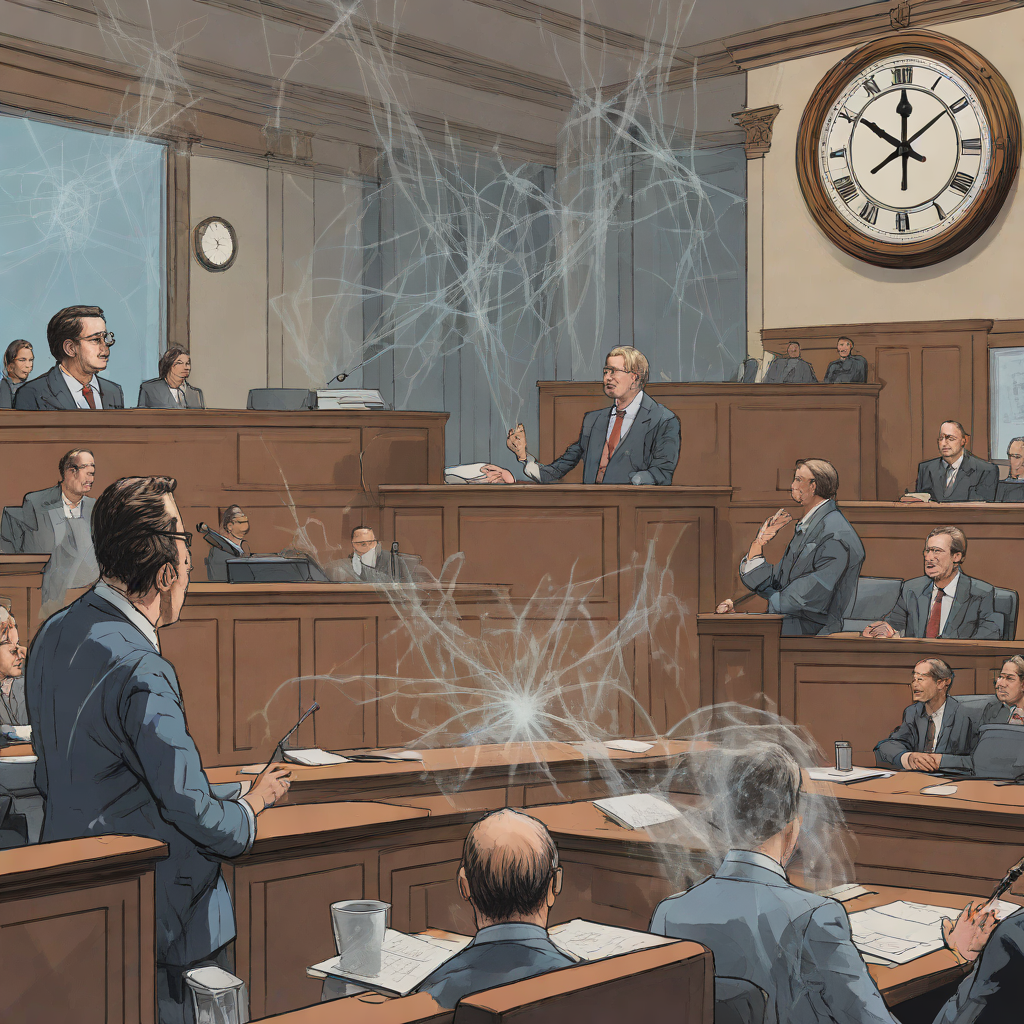
These cases, which began as explosive reckonings for the misinformation surrounding the 2020 election, have curdled into what legal analysts are now calling "zombie litigation"—undead procedural battles that shamble forward without resolution. While the media cycle has moved on to the complexities of the "Adjustment Crisis" and the displacement of white-collar labor by AI, the courts remain entangled in the tedious minutiae of discovery disputes, bankruptcy stays, and endless interlocutory appeals. For David Chen (a pseudonym), a junior associate at a D.C. firm monitoring the docket, the contrast is disorienting. "We are drafting contracts for orbital mining rights in the morning," Chen notes, "and spending the afternoon arguing over the admissibility of a podcast transcript from six years ago. The legal system is operating on analog time in a quantum world."
The persistence of these cases highlights a profound vulnerability in the American defamation framework: its inability to outpace the strategy of attrition. Rudy Giuliani’s strategic use of bankruptcy protection, initially seen as a desperation move, has effectively metastasized into a template for stalling accountability. By tying up the courts in asset valuations and creditor disputes, the core issue—the truth or falsity of the claims made regarding voting machines—remains adjudicated in the court of public opinion rather than a court of law. Similarly, the labyrinthine appeals process utilized by Sidney Powell’s defense team has demonstrated that with sufficient resources, a defendant can effectively run out the clock on public interest.
This glacial pace of justice presents a terrifying precedent for 2026. If the judicial system requires more than half a decade to process the falsehoods generated by a handful of human actors, it is woefully ill-equipped for the era of autonomous disinformation. We are no longer dealing with a singular press conference at Four Seasons Total Landscaping; we are facing a landscape where autonomous agents can generate and disseminate millions of unique, defamatory narratives per hour. The Giuliani and Powell dockets are not just historical artifacts; they are a warning. They reveal that the procedural safeguards designed to protect due process have become the very mechanisms used to deny closure, creating a "liar's dividend" where the punishment for defamation arrives so late that the profit from the lie has long been banked.
The Bankruptcy Defense as a Strategy of Attrition
The filing of a bankruptcy petition acts as a sudden, suffocating brake on the machinery of civil justice. Known in legal circles as the "automatic stay," Section 362 of the Bankruptcy Code was designed to give honest but unfortunate debtors a breathing spell. However, in the high-stakes arena of political defamation—most notably in the relentless post-2020 litigation involving figures like Rudy Giuliani and Sidney Powell—this mechanism has mutated into a potent weapon of attrition. By 2026, the strategic deployment of insolvency has revealed a stark vulnerability in the American legal system: accountability can be deferred until the political news cycle, and the public’s attention span, has long since moved on.
For legal professionals and policy analysts observing the trajectory of these cases over the last six years, the pattern is unmistakable. The moment a defamation verdict looms or discovery becomes too invasive, the bankruptcy card is played. This effectively freezes the civil docket, forcing plaintiffs—often private citizens or companies like Dominion Voting Systems and Smartmatic—to fight a war on two fronts. They must not only prove the falsehood of the claims in civil court but also navigate the labyrinthine, creditor-hostile environment of bankruptcy court to simply keep their claims alive. As noted in a 2025 retrospective by the Columbia Law Review, this tactic transforms a battle over historical fact into a dry, protracted dispute over assets and liabilities, stripping the proceedings of their moral urgency.
The human cost of this procedural limbo is often obscured by the dense legal maneuvering. Consider the plight of election workers who, having secured significant jury verdicts for the reputational damage inflicted by viral conspiracy theories, found their victories hollowed out by immediate bankruptcy filings. The "win" in court established the truth of their conduct, yet the "collection" of that justice—and the finality it brings—was indefinitely postponed. The resulting delay does more than deny compensation; it leaves the original lies to fester in the digital ecosystem, uncorrected by a finalized, enforceable judgment. By the time the bankruptcy trustee resolves the estate years later, the disinformation has often hardened into dogma for millions of voters.
Average Duration of High-Profile Defamation Cases (2015-2025)
Corporate Settlements vs. Individual Impunity
The arithmetic of accountability has fractured into two distinct realities in 2026. On one side sits the corporate boardroom, where liability is a line item and truth is a negotiable asset. On the other lies the chaotic theater of the individual ideologue, where the legal process is not a mechanism for resolution, but a stage for perpetual grievance. This bifurcation was laid bare earlier this month when Fox News Corporation executed yet another massive financial retreat, settling the latest round of defamation claims for an undisclosed sum estimated in the high nine figures. The decision, much like their historic 2023 payout to Dominion Voting Systems, was clinical: a cost-benefit analysis determined that the price of discovery—and the potential exposure of internal communications—far outweighed the cost of writing a check.
For a publicly traded entity, the legal system works as intended. The threat of punitive damages acts as a deterrent, forcing rational actors to cut their losses. Shareholders demand certainty, and litigation is the enemy of stability. But shift the lens to the individual architects of the 2020 election denial narratives—figures like Rudy Giuliani and Sidney Powell—and the deterrent effect evaporates completely. Six years after the initial filings, these dockets remain "undead," shambling through bankruptcy courts and appellate circuits, immune to the rational pressures that brought a media empire to its knees.
The strategy employed by these individual defendants has effectively weaponized procedural due process. By cycling through legal teams, defying discovery orders, and leveraging bankruptcy protections, they have turned the courtroom into a platform for fundraising rather than a venue for fact-finding. As noted by Sarah Miller (a pseudonym), a forensic accountant who has tracked the liquidity of high-profile defamation defendants for over a decade, the financial penalties have become abstract. "When you claim insolvency while simultaneously raising millions in 'legal defense funds' from a radicalized base, the judgment isn't a punishment," Miller argues. "It’s a marketing expense. The lawsuit validates their status as martyrs, and the delay tactics ensure that the 'martyrdom' generates revenue longer than the judgment can take it away."
Average Duration of Defamation Cases: Corporate vs. Individual (2020-2026)
The Evolution of the Lie: Analog to Algorithmic
If the 2020 election challenges were a tragic comedy of errors—forever memorialized by the image of Rudy Giuliani’s melting hair dye and a press conference held between a crematorium and a sex shop—the disinformation landscape of 2026 is a sleek, silent thriller. We have spent half a decade dissecting the "analog lie": the sworn affidavits, the grandiose "Kraken" lawsuits, and the televised hearings. These were distinctly human endeavors, fraught with human incompetence and, crucially, subject to human liability. But while our federal courts remain clogged with the undead dockets of the last administration's legal battles, the mechanism of deceit has fundamentally evolved. We are still litigating the clumsy past while the algorithmic future renders those precedents dangerously obsolete.
Consider the sheer velocity of falsehood. In late 2020, a conspiracy theory regarding voting machines required weeks to migrate from fringe message boards to cable news chyrons. It relied on human conduits—lawyers, anchors, pundits—each of whom represented a potential node of legal liability, as Dominion Voting Systems eventually demonstrated through billion-dollar settlements. Today, that friction has evaporated. The "liar" is no longer a sweating attorney in a rumpled suit, but a decentralized network of autonomous AI agents. These systems, operating on the deregulated infrastructure championed by the current Trump administration, can generate hyper-realistic audio and video evidence in milliseconds, flooding the information ecosystem before a human fact-checker has even poured their morning coffee.
This shift from biological to digital fabrication exposes a fatal asymmetry in our current legal framework. The defamation standards established in New York Times v. Sullivan—the very standards currently protecting media organizations—hinge on "actual malice," defined as knowledge of falsity or reckless disregard for the truth. But how does a plaintiff establish the state of mind of a generative model? As David Chen, a digital forensics specialist at a Georgetown-based policy institute, observes, "We are trying to catch ghosts with a net designed for bears. In 2020, we looked for a smoking gun text message between panicked aides. In 2026, the 'source' is an algorithm maximizing for engagement. There is no malicious intent to deceive in the human sense, only a mathematical intent to optimize. And you cannot depose an optimizer."
Velocity of Falsehood: Time to 1 Million Impressions (Hours)
The Malice Gap: Can Old Laws Catch New AI?
The defining legal legacy of the 2020 election fallout is not the verdicts, but the terrifying durability of the "I believed it" defense. As we stand in early 2026, the glacial pace of the defamation suits against figures like Rudy Giuliani and Sidney Powell has inadvertently stress-tested the New York Times v. Sullivan standard to the point of structural failure. The core requirement for proving defamation against public figures—"actual malice," defined as knowledge of falsity or reckless disregard for the truth—was designed for human editors making conscious choices in smoke-filled newsrooms. It was never built for an era where the defendant can claim their delusion was sincere, or worse, where the defendant is a probabilistic algorithm incapable of "belief" at all.
The procedural quagmire of the last six years has illuminated a "Malice Gap" that technology is now aggressively exploiting. The defense strategy employed by the 2020 cohort was simple yet effective: insulate yourself with enough echo-chamber reinforcement that you can plausibly deny "knowing" the truth. If a human attorney can delay accountability for half a decade by arguing they genuinely believed non-existent voter fraud theories, what happens when the generator of that falsehood is a Large Language Model (LLM)? In 2026, we are witnessing the migration of this legal loophole from human partisans to autonomous agents. When an AI "hallucinates" a defamatory claim about a voting machine or a public official, the question of intent—the very heart of malice—dissolves into a fog of technical complexity.

Pricing the Truth in the Post-Reality Era
In the grim calculus of the Southern District of New York and the bankruptcy courts of Florida, the price of the 2020 election lies is still being tallied, penny by agonizing penny. But as we enter the second month of 2026, with the Trump administration’s deregulation agenda accelerating, the seemingly endless procedural delays in the Giuliani and Powell cases have revealed a terrifying economic reality: the legal system’s "truth tax" is too slow to curb the market. The delay has effectively created a discount window for defamation, signaling to bad actors that the return on investment for high-velocity disinformation outweighs the risk of a penalty that might not arrive for half a decade.
This failure to swiftly close the "undead dockets" of 2020 poses an existential threat in the 2026 information landscape, which is no longer dominated by human pundits but by autonomous AI agents. The transition from human-generated spin to algorithmic content generation has collapsed the cost of producing disinformation to near zero. A 2025 analysis by the Brookings Institution highlighted that while human defamation requires a salary and a platform, an adversarial AI agent can generate millions of defamatory variations per hour for the cost of electricity. If the judicial system takes six years to process a human lie, it is statistically incapable of addressing an algorithmic swarm.
The Lag: Legal Resolution Speed vs. Disinformation Velocity (2020-2026)
We are witnessing a regulatory arbitrage where political operatives can exploit the latency of the courts. The message sent by the lingering dockets is clear: You can borrow credibility today, spend it on a lie to alter an election or a stock price, and perhaps pay it back years later in bankruptcy court—if at all. In a 2026 economy driven by high-frequency trading and high-frequency sentiment analysis, this lag is not a bug; it is a loophole the size of the Constitution. Resolving these cases is no longer about vindicating the past; it is about establishing a "truth cost" high enough to survive the future. If we cannot effectively tax the lie of a man, we have no hope of regulating the hallucination of a machine.