Glass Earth: The Strategic Deconstruction of Tehran’s Subterranean Fortress
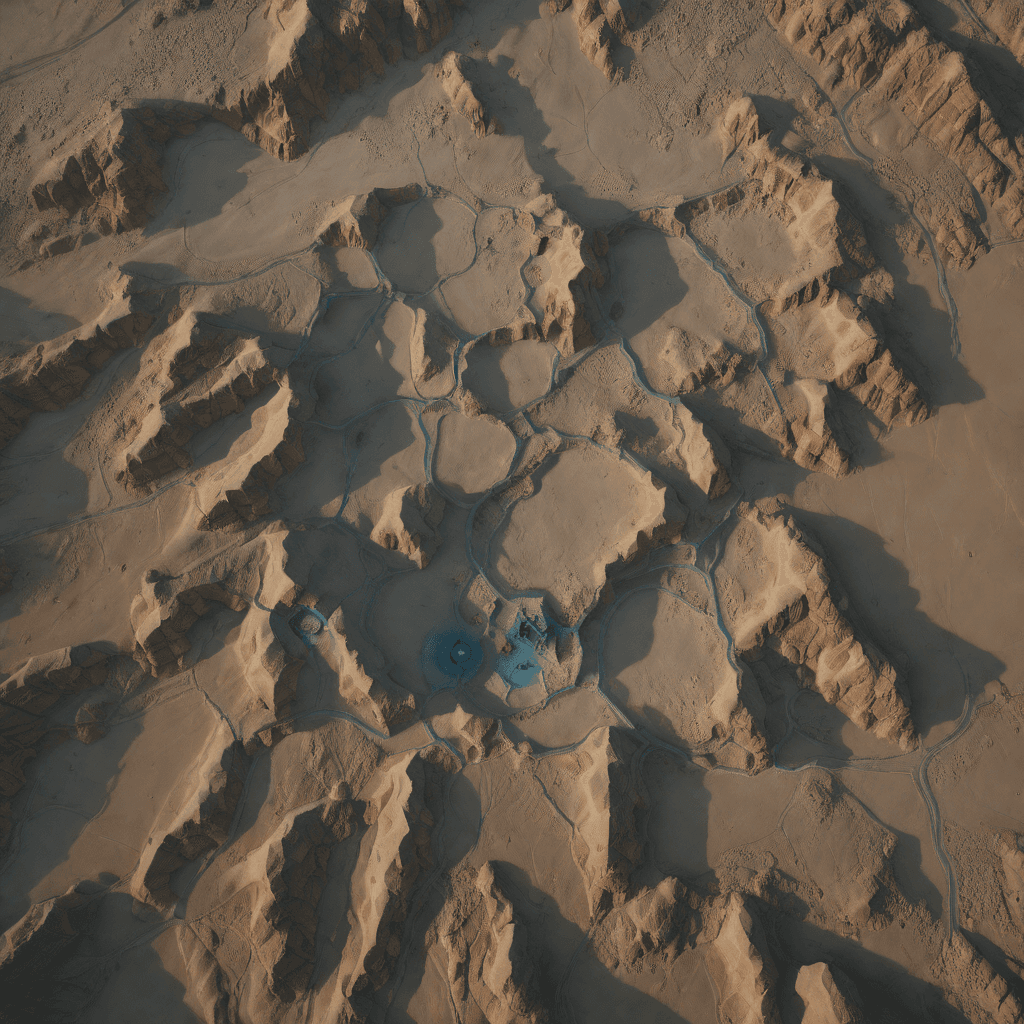
The Subterranean Fortress of Tehran
The Washington-Tehran shadow war has moved deep underground. A six-story command center now serves as the Iranian regime's final redoubt. As oil prices surged 12% past $90 per barrel following the Trump administration’s "unconditional surrender" campaign, the Israel Defense Forces (IDF) publicly unveiled a reconstruction of this "B6" level. Reports from Chosun Ilbo describe the facility as a subterranean maze engineered to survive heavy aerial bombardment.
National security analyst James Carter views this 60-meter-deep complex as the culmination of a decade-long shift toward deep-earth survivalism. By releasing these layouts, the IDF signals that Iran’s physical isolation has been compromised. The bunker is no longer a secure asset but a high-stakes target; in an era of absolute transparency, reinforced concrete cannot provide anonymity.
This single underground complex has dictatated global naval deployments. Seven European Union navies were dispatched as the U.S.-Iran friction intensified, illustrating how regional instability anchors a global crisis.
Redundant Command and the Philosophy of Survival
The Khamenei bunker’s architecture assumes total surface-level collapse. The IDF reconstruction reveals multiple, redundant emergency command nodes designed to operate independently. If one section is breached, the central nervous system remains functional.
This design shifts strategy from traditional "hardened" defense to "distributed" survival. By clustering command nodes 60 meters deep, the Iranian military forces adversaries to launch multiple, precise strikes. Defense specialist David Chen notes that this redundancy responds to the inevitability of modern munition precision; a single direct hit is now a mathematical certainty rather than a possibility.
Tehran is betting that subterranean complexity will exhaust the technical and political patience of its enemies. However, the IDF’s mapping of these nodes suggests that advanced spatial intelligence has already neutralized that strategic advantage.
The Logistical Challenges of Deep-Earth Governance
Governing from 60 meters down requires a self-contained ecosystem. The B6 level must manage air filtration, waste, and secure communications for hundreds of personnel during sustained conflict. Engineering consultant Maria Rodriguez notes that the primary enemies at these depths are earth pressure and thermal regulation rather than just munitions.
Reports from Yonhap News highlight the engineering required to sustain life in these extremes. While deep-earth governance slows communication and restricts leadership mobility, the regime views these hurdles as a necessary cost of sovereignty in the "America First" era.
The bunker provides a psychological anchor for the Iranian bureaucracy, allowing policy execution despite global market turmoil. Yet this infrastructure creates a critical vulnerability: if external vents or communication arrays are destroyed, the 60-meter shield becomes a tomb.
Disclosure as a Strategic Deterrent
The IDF’s decision to publicize the bunker’s blueprints is a move in "cognitive warfare." By proving they possess data on Tehran's most sensitive assets, Israel erodes the regime's sense of safety. Yonhap News reports that the IDF specifically showcased vulnerabilities to strikes reaching exactly 60 meters—a direct warning to the personnel inside.
This disclosure acts as a deterrent that bypasses physical walls. In the Trump 2.0 era of aggressive deregulation and isolationism, the U.S. and its allies rely on such intelligence-heavy maneuvers to achieve goals without full-scale ground intervention. The message: the most "invulnerable" assets are now transparent.
For Iran, this publicized reconstruction is a humiliating breach. It triggers paranoia across all "secret" facilities, forcing costly and time-consuming relocations. The strategic goal is clear: win the battle of intelligence dominance before a single bunker-buster is launched.
Beyond Hardening: The Evolution of Bunker-Busting Capabilities
A 60-meter depth was once the gold standard for invulnerability. Modern munitions have closed that gap. Yonhap News indicates the IDF’s messaging highlights capabilities designed to strike at exactly that depth. This technical evolution suggests that the arms race between earth-penetrating weapons and reinforced concrete has reached a tipping point.
Advanced munitions now use "sequential firing" or "tandem charge" technology. An initial blast clears surface debris, allowing a second penetrator to drive into the bedrock before detonating. James Carter observes that the IDF’s confidence suggests they have calculated the exact kinetic energy required to neutralize the B6 level. Computational precision is rendering 20th-century hardening obsolete.
This shift forces a global reassessment of defense. If a 60-meter-deep maze is this transparent, the concept of a physical "safe zone" is dead. Defense must move toward mobility, deception, and digital obfuscation.
The End of Physical Anonymity in Global Conflict
The Tehran bunker reconstruction marks the end of physical anonymity in military intelligence. In a world where 20 nations are entangled in U.S.-Iran friction, the ability to hide a six-story building has vanished. Satellite imagery, signals intelligence, and human assets have created a "glass earth" effect.
As the Trump administration pursues technological hegemony, surveillance tools have made secrecy a temporary state. The IDF’s reconstruction proves that even the most guarded secrets of a sovereign state can be digitized and displayed.
Power is no longer defined by what a nation can hide, but by what its adversaries can see. The Iranian bunker, once a symbol of defiance, is now a case study in the futility of traditional concealment against a technologically superior opponent.
Sources & References
미로같은 지하 6층... 이스라엘군, 하메네이 벙커 재구성해 공개
조선일보 • Accessed 2026-03-07
美·이란 전쟁에 얽혀든 20국… 분노한 EU 7국 해군 파병 美·이란 전쟁에 얽혀든 20국… 분노한 EU 7국 해군 파병 美·이란 전쟁에 얽혀든 20국 분노한 EU 7국 해군 파병 美·이란 전쟁에 얽혀든 20국… 분노한 EU 7국 해군 파병 美·이란 전쟁에 얽혀든 20국… 분노한 EU 7국 해군 파병 美·이란 전쟁에 얽혀든 20국 분노한 EU 7국 해군 파병 美·이란 전쟁에 얽혀든 20국… 분노한 EU 7국 해군 파병 美·이란 전쟁에 얽혀든 20국… 분노한 EU 7국 해군 파병 美·이란 전쟁에 얽혀든 20국 분노한 EU 7국 해군 파병 늘 배신당한 '중동의 집시' 독립 꿈꾸며 다시 총 들다 늘 배신당한 '중동의 집시' 독립 꿈꾸며 다시 총 들다 늘 배신당한 '중동 집시', 독립 꿈꾸며 다시 총 들다 트럼프 '무조건 항복' 압박… 美유가 12% 급등, 90달러 돌파 트럼프 '무조건 항복' 압박… 美유가 12% 급등, 90달러 돌파 트럼프 '무조건 항복' 압박… 美유가 12% 급등, 9
View Original*연합뉴스 (Yonhap News)
연합뉴스 • Accessed 2026-03-07
**전체 제목:** 이스라엘, '하메네이 제거' 벙커 재구성 영상 공개... "지하 60m까지 타격" [URL unavailable]
What do you think of this article?