The Macintosh Ghost: Why a 2023 Viral Moment Haunts Apple's 2026 Identity
A Viral Echo from Mumbai
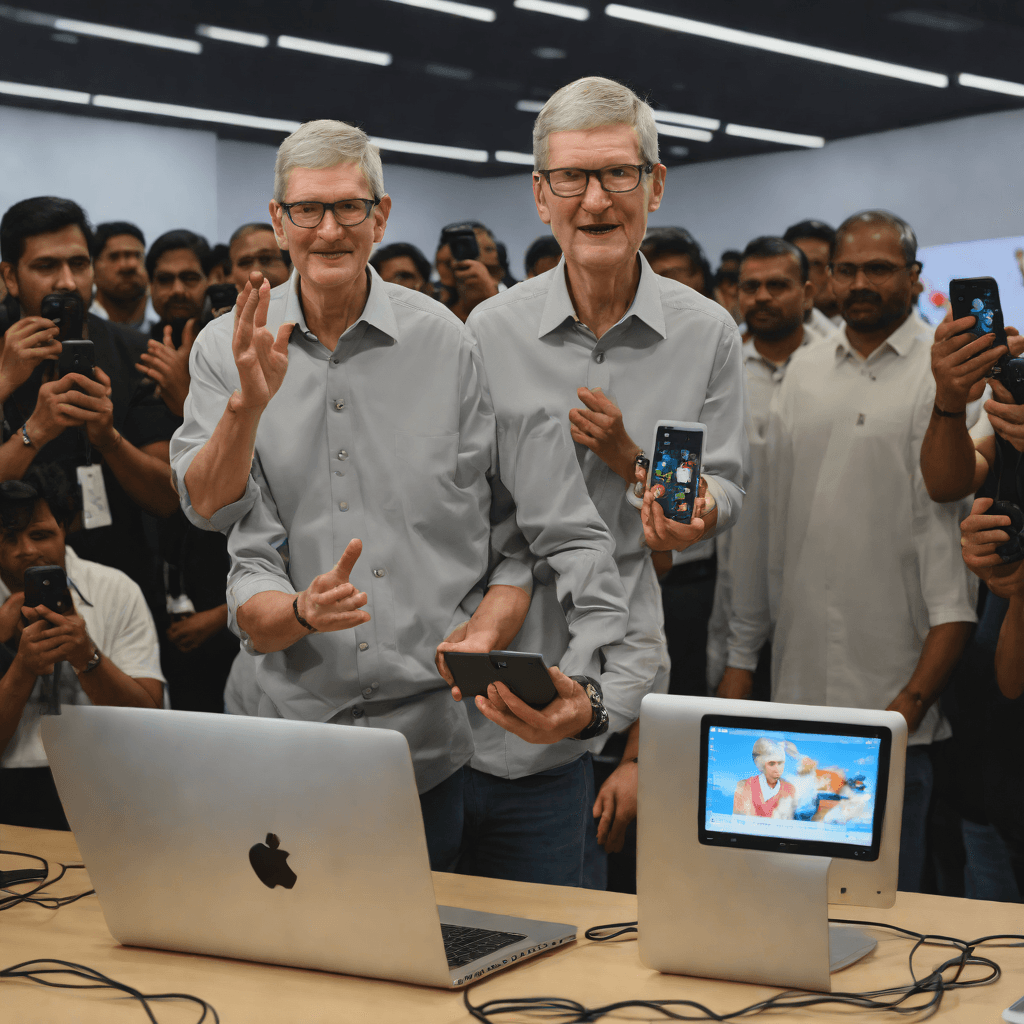
The video is grainy, shot from a crowd angle that captures the humid chaos of Mumbai in April 2023, yet it has become the defining artifact of the American internet in February 2026. In the clip, Apple CEO Tim Cook stands at the opening of the company’s first flagship store in India, his polished executive veneer momentarily cracking as a fan presents him with a preserved Macintosh 128K from 1984. Cook’s reaction—a genuine, almost boyish wideness of the eyes, followed by a reverent touch of the beige plastic—transcends the usual corporate theater. While this interaction is nearly three years old, its sudden dominance on social feeds this week speaks less to historical interest and more to a collective psychological recoil from the present.
In an era where "technology" has become synonymous with invisible, agentic AI systems and regulatory battles, this thirty-second loop offers a tactile anchor to a time when innovation was something you could physically hold. The resurgence of this clip is not an algorithmic accident, but a signal of consumer fatigue amidst the aggressive "Trump 2.0" deregulation that has accelerated AI integration at the cost of transparency. Social media analytics firms indicate that the video is being shared primarily by users who tag it with sentiments of longing for "hard tech" rather than "soft agents."
For David Chen, a senior UI designer based in Seattle, the video resonates as a critique of his own changing profession. "I watched that clip five times yesterday because it shows a CEO actually looking at a computer," Chen explains, noting that his daily workflow is now dominated by prompting localized AI clusters rather than drawing pixels. "In 2026, we don't build things; we guide agents that build things. Seeing Cook touch that old Mac reminds me of when we had direct agency over the work. It’s comforting because it’s finite."

The Supply Chain Architect's Twilight
This nostalgia wave crashes directly against the current administration's push for "unfettered acceleration," creating a cultural friction that Apple must navigate. Cook’s legacy, defined by operational brilliance rather than product theology, now faces its most existential threat from the very geopolitical forces he once navigated with diplomatic grace. The "America First" isolationism of the Trump administration has turned the global supply chain—Cook’s true masterpiece—into a liability. With tariffs threatening the delicate web of assembly lines stretching from Vietnam to India, the effortless ubiquity of the iPhone is colliding with the friction of 2026 borders.
The Mumbai video, with its cheering crowds and tactile reverence for the glass-and-steel temple of the Apple Store, captures a moment when the device itself—the iPhone, the Mac—was the undisputed center of the user's universe. However, the ground beneath that fortress has shifted tectonically. Elena Rodriguez, a former supply chain analyst now consulting for domestic chip fabricators, notes the palpable shift. "The old playbook of 'Designed in California, Assembled in China' isn't just politically toxic; it's operationally unfeasible under the new tariff regime," she argues. "Cook built the greatest global machine in history, but the machine is being told to run in reverse."
This regulatory tightening is not merely theoretical; it is reshaping the unit economics of the devices in our pockets. The administration’s aggressive tariff schedules on imported high-end semiconductors and offshore assembly services have forced a difficult calculation on Silicon Valley giants. Mark Stevenson, a procurement strategist for a mid-sized consumer electronics firm in San Jose, points to a 15% rise in component landing costs over the last six months. "We used to optimize for speed and global efficiency," Stevenson notes. "Now, we are optimizing for tariff avoidance. We are essentially re-engineering our supply chains not for innovation, but for compliance with the new trade borders."
Hardware Fetishism in the Age of Invisible AI
Apple’s pivot toward "Agentic AI" serves as a strategic hedge against this hardware isolationism, yet it introduces a new layer of conflict with the prevailing deregulatory ethos. The Macintosh 128K was a product of American manufacturing romanticism; the iPhone 17 is a product of globalism that is currently being dismantled by executive order. This tension is exacerbated by the fundamental nature of the Artificial Intelligence integration that defines Apple’s 2026 roadmap. As the company pivots to "Agentic" interfaces—where the OS anticipates needs rather than waiting for commands—the distance between user and machine widens further.
The 1984 Mac required you to insert a floppy disk; the 2026 Siri OS proactively drafts your emails and manages your calendar before you even unlock the screen. While efficient, this shift surrenders human agency in a way that the "bicycle for the mind" metaphor never intended. Michael Johnson, a senior analyst at a Manhattan-based tech fund, describes this phenomenon as "hardware fetishism." "We buy the device to prove we still own the technology, even as the intelligence behind it moves to a server farm in Nevada we will never see," Johnson states. "The fervor surrounding physical store openings and unboxing rituals has intensified, not because the hardware is revolutionary, but because it is the only part of the ecosystem we can still touch."
This clinging to the physical is a geopolitical necessity in the Trump 2.0 era. The administration’s re-industrialization policies favor items that can be stamped with "Made in USA." It is straightforward to place a tariff on a titanium chassis; it is infinitely harder to regulate an algorithmic agent that exists across distributed data centers. Consequently, Apple finds itself performing a delicate theater: celebrating the "beautiful object" to appease Washington’s manufacturing focus and consumer vanity, while quietly pivoting its massive R&D budget toward the invisible infrastructure of AGI.
Beyond the Beige Box: The Ternus Transition
Ultimately, the ghost of the 2023 Mumbai opening haunts Apple because it represents a bifurcated identity that is becoming impossible to maintain. On one side, the company requires the growth engines of international markets to survive. On the other, it must perform obeisance to an administration that views such interdependence as a strategic vulnerability. The tactile, human-centric design philosophy that defined the Jobs era is being squeezed between the cold logic of trade wars and the intangible, algorithmic nature of the new AI economy.
Industry observers suggest this viral nostalgia is far from accidental. With John Ternus, Apple’s hardware engineering chief, increasingly positioned as Cook's likely successor, the resurgence of "Golden Age" imagery serves as strategic "legacy padding." By anchoring the brand's identity in tangible hardware excellence—Ternus's domain—Apple is subtly preparing stakeholders for a transition of power. The strategy aims to solidify the company's reputation as a product-first entity before the full pivot to invisible, agentic systems potentially alienates its core base.
In 2026, the definition of an Apple product has fundamentally shifted from a tool you hold to an intelligence you inhabit. The "Beige Box" paradigm—computing as a discrete, desktop activity—has fully dissolved into ambient computing. As the Board of Directors looks toward the post-Cook horizon, they face an existential choice: appoint a successor who will polish the legacy of the physical device, or one who is willing to cannibalize it to build the invisible, agentic future that the market now demands. To survive this transition, Apple must convince a skeptical public that this invisible hand is an extension of their will, not a replacement for it, transforming the company from a purveyor of luxury hardware into the world's first privatized custodian of digital agency.
What do you think of this article?