The Saturated State: Why Britain’s Infrastructure Collapse Signals a Global Adjustment Crisis
The Liquefaction of a G7 Economy
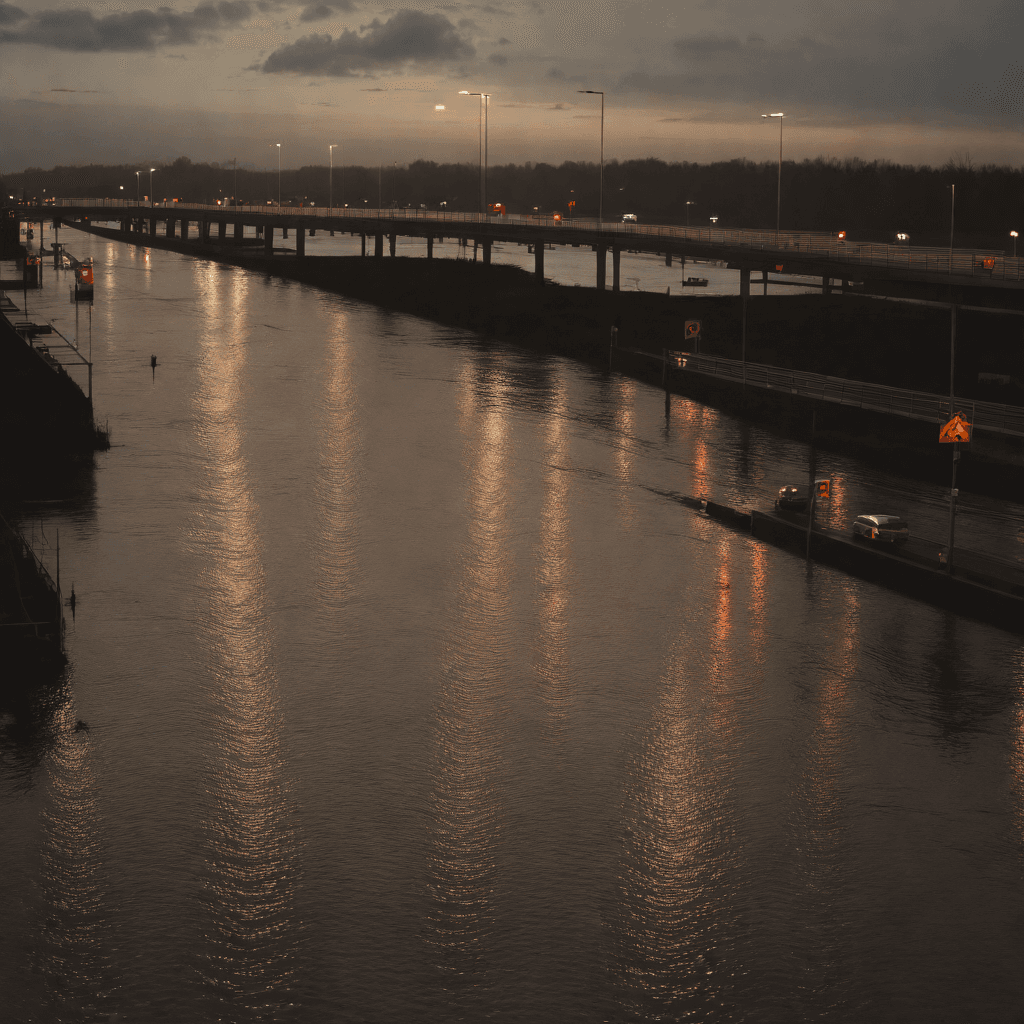
The British Isles are undergoing a literal and figurative liquefaction. As of February 10, 2026, the physical ground beneath the world’s sixth-largest economy has reached a state of total saturation. Data from the Environment Agency confirms 104 active flood warnings and 177 flood alerts across England—a statistical red alert that signals more than a seasonal storm. This "Great Saturation" follows a month where rainfall totals surged to 150% of the January average, rendering the landscape incapable of absorbing further moisture.
For US policymakers and infrastructure investors, the scenes of submerged motorways and rural isolation are a clinical demonstration of the 2026 "Adjustment Crisis." This period is defined by a systemic decoupling of technological ambition from material maintenance. While the Trump administration in Washington aggressively pushes for digital hegemony and AI-driven deregulation, the UK’s struggle suggests that nations secured by digital firewalls remain physically vulnerable to the most ancient of threats: gravity and groundwater.
The Band-Aid Engineering of Deferred Maintenance
The systemic vulnerability is most visible in the reactive engineering now required to keep primary transit arteries open. The temporary ramps once installed at sites like the A29 at Shripney during the 2024 floods have become a haunting precedent for 2026; what were intended as emergency measures are now permanent fixtures of a landscape in retreat. These tactical maneuvers highlight a broader strategic failure: the long-term neglect of foundational infrastructure like drainage and culverts in favor of fiscal austerity and digital hype.
The current atmospheric gridlock, characterized by a "blocked" weather pattern of high pressure to the north and east, has trapped low-pressure systems directly over the UK. Met Office meteorologists indicate there is no immediate end in sight. This meteorological stagnation mirrors the political gridlock in London, where the government remains fixated on the fallout from the leaked Epstein files—a scandal involving the monarchy that some analysts argue is serving as a "Dead Cat" strategy to distract the public from the total physical failure of state infrastructure.
A Transatlantic Mirror: The Cost of Physical Shocks
For global risk managers, the economic implications are immediate. Infrastructure analysts tracking transatlantic supply chains observe that the disruption to UK logistics is a precursor to the "physical shocks" that deregulation-heavy platforms often ignore. While the current US administration champions a deregulatory surge in automated manufacturing, the disparity remains stark: a 150% increase in rainfall against the baseline has not been met with a corresponding increase in drainage investment. This is the heart of the Adjustment Crisis—a society that can process a billion transactions in a millisecond but cannot move a freight truck through three inches of standing water.
The crisis has also exposed the limits of "Task-Shifting" strategies, which have attempted to use automated monitoring to replace physical inspections. While 6G-enabled sensors can identify rising water levels with unprecedented precision, they cannot repair a breached levee or unblock a Victorian-era culvert. As the Met Office forecasts an additional 30mm of rain across southern England, the debate over "Liberty vs. Security" takes on a material dimension. Does a nation truly possess the liberty of a free market if its physical connectivity is held hostage by a predictable, yet unmanaged, hydrological cycle?
The Mirage of Deregulated Resilience
The deregulation wave of the mid-2020s, mirrored by post-Brexit UK policies, has shifted the burden of disaster resilience from the state to local market actors. This reactive, "just-in-time" approach treats public safety as a variable cost rather than a foundational obligation. In Scotland, the Scottish Environment Protection Agency (SEPA) has issued multiple warnings for river catchments, proving the crisis is national in scope.
Critics of the current US infrastructure strategy argue that the "America First" pivot has led to a dangerous withdrawal from international climate and engineering standards. While the EU entrenches itself behind digital privacy walls, the United States faces its own version of the Adjustment Crisis, attempting to reconcile a booming AI sector with a power grid and transport network susceptible to cascading failures. As the ground remains saturated, even minor downpours trigger immediate crises. This saturation is both literal and metaphorical: modern systems are too heavy with technological debt to absorb the shocks of a changing environment.
Rebuilding the Material Social Contract
To rebuild the social contract in 2026, nations must move beyond the "Speed Fallacy"—the idea that rapid digital growth can compensate for physical fragility. The current inundation serves as a stark physical rebuke to the digital triumphalism of the decade. The UK’s inability to manage predictable rainfall after the sequence of storms culminating in Chandra proves that while we may live in a digital age, we still survive in a physical one.
The 104 flood warnings in England are signals to policymakers that the era of deferred maintenance has reached its terminal point. As nations retreat behind digital walls and isolationist policies, the physical environment continues to operate on a global scale that ignores borders and tariffs alike. We are entering an age where the most valuable asset a nation can possess is not its algorithm, but its ability to maintain the physical ground upon which its citizens stand. If we have built a civilization capable of simulating the universe within a silicon chip, we must now find the will to manage the rain.
Sources & References
Flood warnings and alerts for England
Environment Agency • Accessed 2026-02-09
As of February 9-10, 2026, over 104 flood warnings and 177 flood alerts are active across England due to persistent rainfall. Saturated ground has significantly increased the risk of surface and river flooding.
View OriginalUK Weather Warnings
Met Office • Accessed 2026-02-09
Yellow weather warnings for rain have been issued for southern England and South Wales. A blocked weather pattern caused by high pressure to the north is trapping low-pressure systems over the UK.
View OriginalFlood warnings for Scotland
Scottish Environment Protection Agency (SEPA) • Accessed 2026-02-09
Multiple flood warnings and alerts are active in Scotland, specifically focusing on vulnerable river catchments following heavy downpours.
View OriginalA29 Shripney flood management
West Sussex County Council • Accessed 2026-02-09
Local authorities are implementing emergency measures, including temporary ramps and road closures, to manage rising water levels on key infrastructure routes.
View OriginalTotal active flood warnings in England: 104
Environment Agency • Accessed 2026-02-09
Total active flood warnings in England recorded at 104 (2026)
View OriginalRainfall compared to January average: 150%
Met Office • Accessed 2026-02-09
Rainfall compared to January average recorded at 150% (2026)
View OriginalActive flood alerts (flooding possible): 177
Environment Agency • Accessed 2026-02-09
Active flood alerts (flooding possible) recorded at 177 (2026)
View OriginalDan Stroud, Operational Meteorologist
Met Office • Accessed 2026-02-09
Unfortunately, there's no end in sight. We've got a big area of high pressure to the north and east stopping areas of low pressure from moving through.
View OriginalAlex Deakin, Meteorologist
Met Office • Accessed 2026-02-09
It is a very soggy day for much of the UK. The ground is already saturated, making these downpours particularly concerning for flood-prone areas.
View OriginalWhat do you think of this article?