Fatal Precision: Why Early Warnings Fail America’s New Tornado Frontlines
Title: Fatal Precision: Why Early Warnings Fail America’s New Tornado Frontlines
The Midnight Vortex in the Great Lakes
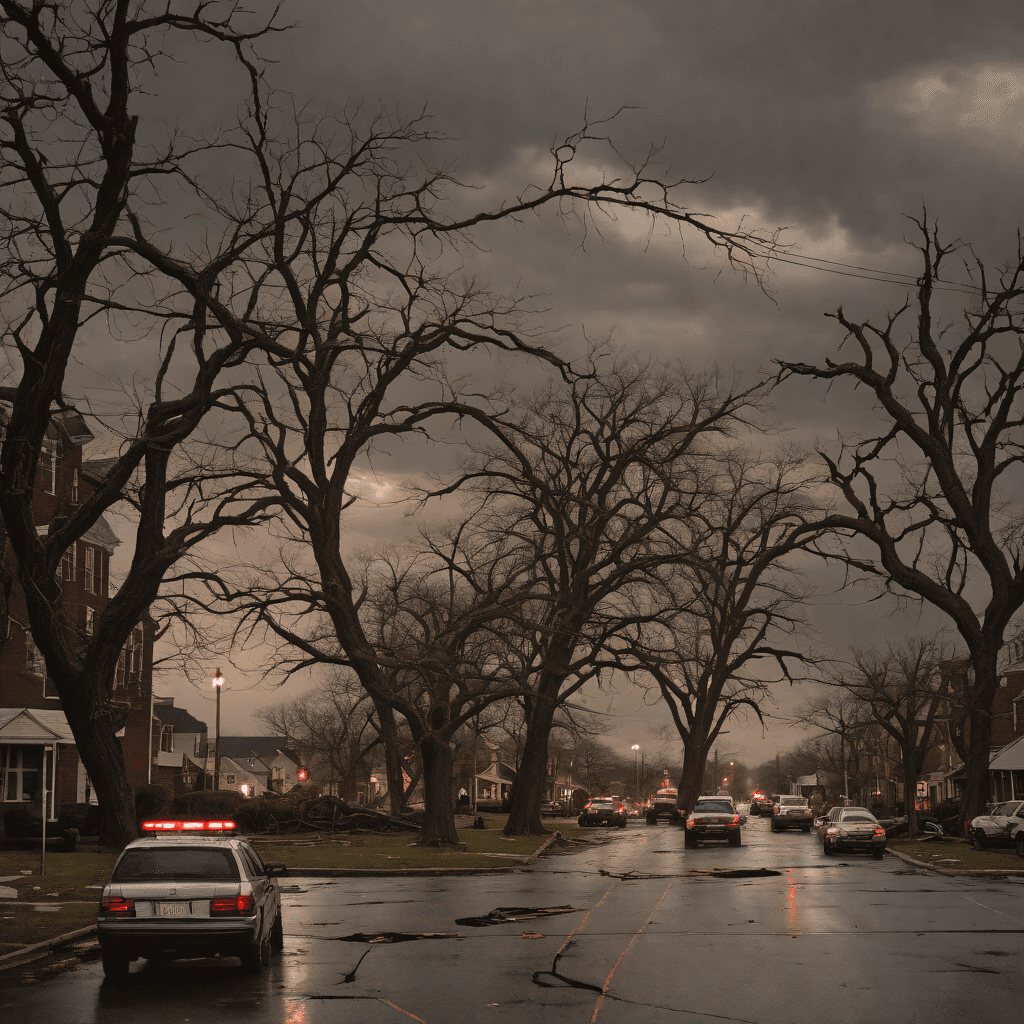
The northward expansion of volatile weather patterns reached a lethal peak over the March 7–8 weekend, with recovery efforts dominating the national landscape on Monday, March 9, 2026. As an early-spring storm system claimed six lives across Michigan and Oklahoma, the emergence of an EF-3 vortex in Michigan underscores a growing geographical mismatch between historical risk and current climate reality (PBS). Among the victims was a 12-year-old boy in Michigan, a tragedy that has catalyzed a national debate on the adequacy of regional preparedness in states previously considered outside the high-risk "Tornado Alley" (BBC, NBC News).
For Michael Johnson (Pseudonym), a resident who witnessed the destruction, the speed of the event defied local expectations. The storm leveled structures with such force that search teams combed debris fields for survivors throughout the weekend (NPR). This localized devastation occurred even as national attention was diverted by a surge in global oil prices above $110 and escalating Middle East tensions (BBC, CBS News). The coincidence of these events highlights the difficulty of maintaining public focus on domestic civil defense while the Trump administration manages a volatile energy market and burgeoning conflict in Iran (NYT).
The fatalities were not limited to the Midwest; the same system swept through the central U.S., claiming lives in Oklahoma, including a mother and daughter (PBS, CBS News). This multi-state outbreak reflects atmospheric dynamics where high-energy systems increasingly maintain destructive integrity across vast distances. While Oklahoma residents are often structurally conditioned for such events, the penetration of an EF-3 storm into Michigan indicates that the Great Lakes are becoming a new frontline for severe weather, necessitating an urgent reevaluation of federal vulnerability mapping.
The Migration of the Storm Corridor
Shifting climatological patterns are redrawing the American risk map, pushing extreme wind events further north and east. Experts characterized the recent outbreak as a "rare early-March" event, a timeframe that traditionally sees northern states protected by lingering winter stability (CTV News). This shift suggests the traditional tornado corridor is no longer a static geographic fixture but a moving target requiring a radical update of state-level emergency protocols.
In Michigan, the shock of a high-intensity tornado so early in the year exposed a lack of "storm literacy." Sarah Miller (Pseudonym), a local emergency coordinator, noted that many residents still view tornadoes as a southern or summer problem, leading to dangerous delays in seeking shelter after alerts are issued. This perception is increasingly at odds with data showing that the transition from winter to spring is becoming more violent and less predictable.
The migration of these storm corridors demands a pivot in regional vulnerability categorization. If the Great Lakes are to face EF-3 level threats with increasing frequency, historical reliance on seasonal "readiness months" must be replaced by year-round vigilance. The administration’s focus on domestic resilience must now contend with the fact that the geography of the homeland is undergoing a structural change, rendering old safety maps obsolete. This shift creates a lethal mismatch between atmospheric threats and the physical resilience of local housing stocks.
The Structural Gap in Suburban Defense
Regional survival rates often trace back to the "structural gap" in residential infrastructure. While decades of exposure prompted stricter building codes and reinforced safe rooms in the Deep South, upper Midwest housing often prioritizes snow-load capacity over the lateral force of 150-mph winds. The death of a 12-year-old in a residential area suggests that even homes with basements may provide insufficient protection if the upper structure is not hardened against catastrophic failure (UPI, PBS).
David Chen (Pseudonym), a parent in a recently developed suburban tract, observed that while his home meets local codes, there was no requirement for a dedicated storm shelter or reinforced "hard-point" during construction. This lack of retroactive hardening is a systemic vulnerability. Unlike the traditional Tornado Alley, where community shelters are common, northern suburbs are often "shelter deserts," leaving families to rely on interior bathrooms or basements that can become traps if the house collapses above them.
This structural gap is exacerbated by an economic environment where deregulation is prioritized over costly mandates. While policies reducing federal oversight may spur development, they can also slow the adoption of universal building standards needed to mitigate "last-mile" failures. The challenge for urban planners is reconciling affordable housing with the requirement for high-wind resistance. Beyond physical walls, the efficacy of warnings faces a psychological bottleneck.
Alert Fatigue and the Last Mile Problem
Despite NOAA's record accuracy in predicting the recent storm's path, the "last-mile" of emergency communication remains a critical failure point. Alert fatigue—where residents become desensitized to frequent mobile notifications—can lead to fatal hesitation. In the Michigan and Oklahoma strikes, the technical success of the warning system was negated by delayed human response (The Age).
The friction between digital alerts and physical action concerns emergency managers. While a smartphone delivers warnings in seconds, it cannot compel a resident to move to a shelter. James Carter (Pseudonym), a digital communications expert, argues that the current system relies too heavily on the assumption that an informed citizen is a protected citizen. In reality, the "last-mile" problem is rooted in psychology and physical access, not just data transmission.
Furthermore, the limits of mobile-only systems are exposed in areas with inconsistent cellular coverage. When multiple states face weather emergencies while the nation tracks global conflict and oil shocks, the noise of the digital ecosystem can drown out life-saving signals. Refining the "last-mile" requires moving toward automated physical interventions, such as smart-home systems that automatically secure structures when a tornado signature is detected. Addressing these failures requires overcoming financial barriers to safety.
The Economic Barrier to Retroactive Safety
The financial cost of hardening infrastructure against a new risk map is staggering. For homeowners in newly vulnerable zones, installing a certified storm shelter can cost between $5,000 and $15,000—a price point out of reach for many middle-class families. This economic divide ensures that safety becomes a luxury rather than a standard feature of American life.
Maria Rodriguez (Pseudonym), an insurance industry analyst, noted that the new risk map is already impacting premiums in the Great Lakes. As insurers reassess the likelihood of EF-3 events in Michigan, homeowners face wind-hazard surcharges similar to those in the South. This creates a feedback loop where the cost of living increases without improving physical safety, as premiums rarely translate directly into structural retrofitting.
The federal government’s role in bridging this gap remains contentious. Under current fiscal policies, the preference is for private-sector solutions over large-scale federal subsidies. However, without tax incentives or low-interest safety loans, the transition to a wind-resistant North will remain slow. These constraints ultimately demand a transition from individual responsibility to systemic policy mandates. Moving forward, the integration of storm-resistance into the broader economic safety net will be the deciding factor in whether northern communities can adapt to their new climatological reality or remain perpetually vulnerable to shifting storm corridors.
Policy Options for a High-Wind Future
Adapting to a high-wind future requires a shift from reactive management to proactive hardening. One proposed path involves hardening public schools to serve as dual-use community shelters. By mandating that new educational facilities include storm-rated wings, states can create safety hubs to protect populations during last-mile failures.
Another strategy focuses on shelter mandates for new residential developments. Similar to fire safety requirements, these would require developers to include communal or individual shelters in every new subdivision. While this increases initial construction costs, it internalizes the cost of safety at the point of sale. Rodriguez (Pseudonym) suggests such mandates could eventually lower insurance rates, providing long-term economic benefits.
Ultimately, the goal is to ensure survival is no longer dependent on infrastructure defaults. By integrating weather resilience into urban planning, the U.S. can move toward a future where a child’s life is not dependent on a region’s seasonal memory, but on the physical integrity of their immediate surroundings. Success will depend on leaders prioritizing long-term protection over short-term deregulation.
The March 2026 tornado outbreak underscores a critical juncture in American civil defense. As the boundaries of "Tornado Alley" dissolve, the nation’s survival strategy must evolve from simply watching the skies to hardening the ground. Aligning 21st-century predictive precision with a renewed commitment to structural resilience is the only path toward ensuring that "early warnings" translate into saved lives in an increasingly volatile century.
Sources & References
Boy, 12, among six dead as tornadoes hit Michigan and Oklahoma
BBC • Accessed 2026-03-09
BBC Homepage Live . Live . Mojtaba Khamenei to succeed his father as Iran's supreme leader as oil prices surge Khamenei is named as successor to his father, Ayatollah Ali Khamenei, who was killed in the first wave of US and Israeli strikes. Attribution Middle East Oil prices surge above $110 and shares slide over Iran war Attribution Business Who is Mojtaba Khamenei, Iran's new supreme leader?
View OriginalAuthorities searching debris after suspected tornadoes kill 6 in Michigan, Oklahoma
NPR • Accessed 2026-03-09
Mojtaba Khamenei (center), pictured here in 2019, is the son of former Iranian Supreme Leader Ayatollah Ali Khamenei. He was selected as the country's next supreme leader. Rouzbeh Fouladi/Middle East Images/AFP via Getty hide caption toggle caption Rouzbeh Fouladi/Middle East Images/AFP via Getty Mojtaba Khamenei (center), pictured here in 2019, is the son of former Iranian Supreme Leader Ayatollah Ali Khamenei. He was selected as the country's next supreme leader.
View OriginalAt least six dead after tornadoes hit Michigan and Oklahoma, including 12-year-old boy
Joe.ie • Accessed Sun, 08 Mar 2026 16:56:00 GMT
© 2026 Joe.ie or its affiliated companies. All rights reserved. © 2026 Joe.ie or its affiliated companies. All rights reserved. Rookie or Race-goer: Your unofficial guide to the Cheltenham Festival Iran Live: Tehran promises revenge for supreme leader’s killing A compelling new Irish mystery thriller is available to watch from this week The top 5 baby boy names in Ireland for 2025 and the meanings behind them Rookie or Race-goer: Your unofficial guide to the Cheltenham Festival JOE X BOYLE sport
View Original12-year-old boy among 6 dead as tornadoes rip across Michigan and Oklahoma
NBC News • Accessed Sun, 08 Mar 2026 02:51:00 GMT
NBC News Logo Iran war Politics U.S. News World Sports Local New York Los Angeles Chicago Dallas-Fort Worth Philadelphia Washington, D.C. Boston Bay Area South Florida San Diego Connecticut Shopping Tipline Business Health Culture Science Subscribe Subscriber Hub Saved Newsletters Profile Subscription Preferences Search Search Sections U.S.
View Original*Summary: A massive storm system spawned an EF-3 tornado in Michigan and claims at least six lives across two states, including a mother and daughter in Oklahoma and a 12-year-old boy in Michigan.
pbs • Accessed 2026-03-06
By — Dave Collins, Associated Press Dave Collins, Associated Press By — Steve Karnowski, Associated Press Steve Karnowski, Associated Press By — Mike Householder, Associated Press Mike Householder, Associated Press Leave your feedback Share Copy URL https://www.pbs.org/newshour/nation/authorities-search-debris-after-suspected-tornadoes-kill-6-in-michigan-and-oklahoma Email Facebook Twitter LinkedIn Pinterest Tumblr Share on Facebook Share on Twitter Authorities search debris after suspected torn
View Original*Summary: WTHR details the recovery efforts and the community's grief following the death of a young boy during a rare early-March tornado outbreak in the Midwest.
ctvnews • Accessed 2026-03-06
Mojtaba Khamenei, son of former supreme leader, named successor Iranian state TV early Monday said Mojtaba Khamenei, son of the country’s late supreme leader, has been named his successor.
View OriginalSix dead as tornadoes hit Michigan, Oklahoma
The Financial Express | First Financial Daily of Bangladesh • Accessed Sun, 08 Mar 2026 18:00:00 GMT
India's West Bengal Police Special Task Force (STF) has arrested... CHATTOGRAM, Mar 8 (BSS): Amid escalating tensions in the Middle... The private sector activity in the country expanded at a... Bangladesh has reiterated its commitment to strengthening mutually beneficial and... Chief whip Md Nurul Islam and six whips of the... The High Court (HC) on Sunday granted bail to former... Police have recovered six unexploded sound grenades from inside the...
View Original‘It’s lifting houses!’ At least six dead as suspected tornadoes hit Michigan, Oklahoma
The Age • Accessed Sat, 07 Mar 2026 22:55:49 GMT
Thank God it’s Monday newsletter News, advice and perspectives to help make your job work for you. Mini Crossword How quickly can you solve our new pocket-sized puzzle? Take The Age quiz Test your knowledge of Melbourne and Victoria with Stephen Brook’s quiz.
View OriginalAuthorities search debris after suspected tornadoes kill 6 in Michigan and Oklahoma
PBS • Accessed Sat, 07 Mar 2026 18:37:41 GMT
PBS Providing Support for PBS.org Learn More about PBS online sponsorship Support for PBS provided by: Catch Up on the Latest News PBS NEWS Here’s What To Know About International Women’s Day PBS NEWS New Wave of Strikes Hit Tehran PBS NEWS Doing Your Own Taxes?
View OriginalAt least 6 dead after tornadoes rips through Michigan and storms hit central U.S.
CBS News • Accessed Sat, 07 Mar 2026 02:28:00 GMT
Live Mojtaba Khamenei named supreme leader of Iran as war rages on President Trump said the U.S. has been successful in diminishing the Iranian military and regime, and will continue to expand its targets inside Iran. updated 22M ago Airstrikes alone unlikely to result in regime change in Iran, expert warns Fears for Americans jailed in Iran war zone: "He must be feeling very helpless"
View OriginalAfter Tornadoes Ravage Michigan and Oklahoma, Residents Survey Damage - The New York Times
The New York Times • Accessed Sat, 07 Mar 2026 18:41:43 GMT
New York Times - Top Stories Iran Names Mojtaba Khamenei as Supreme Leader LIVE March 9, 2026, 12:03 a.m. ET Son of Slain Ayatollah Is Expected to Continue Hard-Line Theocratic Rule Mr. Khamenei, 56, was appointed by a committee of senior Shiite clerics after his father was killed at the start of the U.S.-Israeli war on Iran. U.S.
View OriginalTornadoes kill at least six people in Michigan and Oklahoma
upi.com • Accessed Sat, 07 Mar 2026 17:05:26 GMT
Tornadoes kill at least six people in Michigan and Oklahoma
View OriginalWhat do you think of this article?